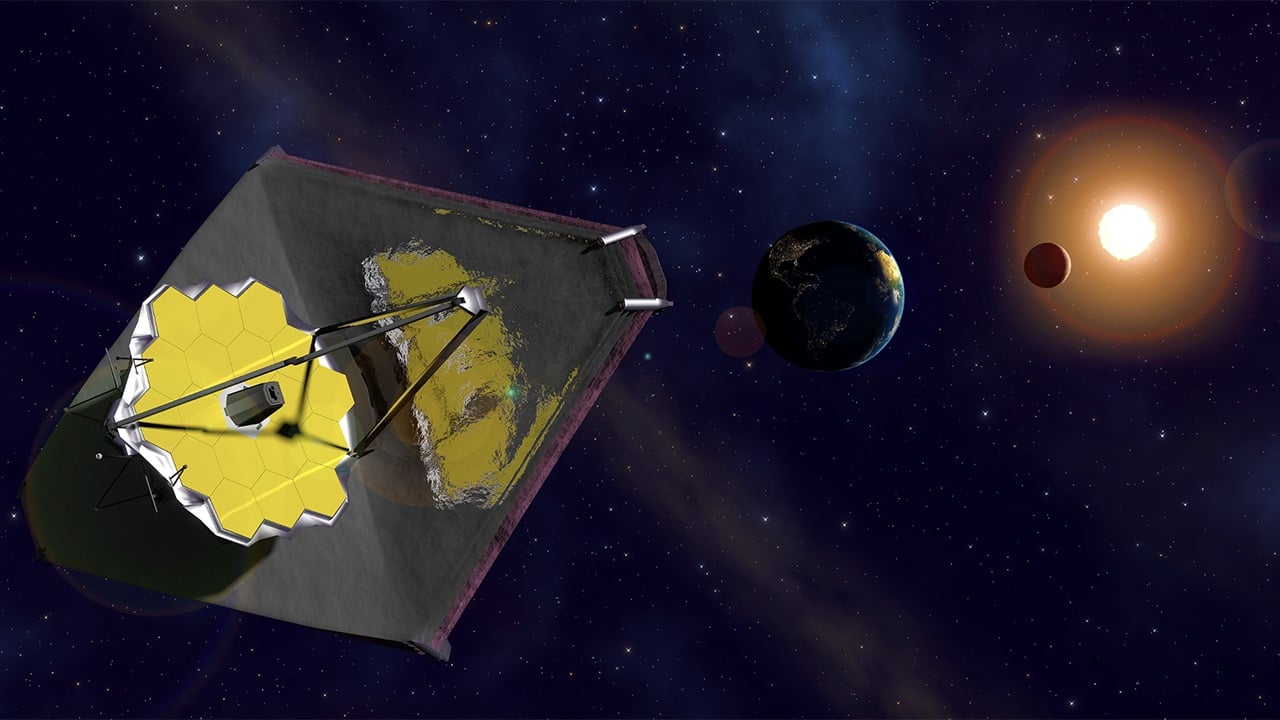
Image by Kevin Gill, from Flickr
Webb Telescope Discovers Elusive Ice In Space
- Written by Kiara Fabbri Former Tech News Writer
- Fact-Checked by Justyn Newman Former Lead Cybersecurity Editor
Scientists using the James Webb Space Telescope (JWST) have made a new discovery. A type of ice previously only observed in labs has been found in space for the first time. The results of their observations were published this week in Nature Astronomy. This “fluffy ice” could hold the key to understanding the chemistry that led to life on Earth.
Normal ice has a tightly packed structure, but this interstellar ice is different. It’s less compact, similar to powdery snow. This allows some water molecules to have “dangling bonds.”
Imagine a water molecule (H2O) with two hydrogen atoms. In regular ice, both hydrogens are firmly linked to the central oxygen. However, in this unusual ice, one hydrogen might not be fully bonded, leaving it dangling outwards.
These dangling bonds create unique light signatures detectable in labs. However, these specific light frequencies are absorbed by Earth’s atmosphere, making it difficult to find them in space.
A team led by astronomer Jennifer Noble from Aix-Marseille University used the JWST’s powerful infrared spectrometer to peer into the star-forming region Chamaeleon I cloud, located roughly 500 light-years away.
They detected two specific light frequencies remarkably similar to those observed in lab-made dangling bond ice. One signature likely represents light reflected directly by the ice, while the other could be from ice interacting with other molecules like carbon monoxide.
Understanding how this special ice behaves is crucial for comprehending the formation of planets and the complex organic molecules essential for life.
“Our results provide insights into the initial, dark chemistry stage of the formation of ice on the interstellar dust grains that will grow into the centimeter-sized pebbles from which planets form in disks,” said Melissa McClure, an astronomer at Leiden Observatory in the Netherlands and the principal investigator of the observing program, as well as the lead author of the paper detailing this discovery. “These observations open a new window on the formation pathways for the simple and complex molecules that are needed to make the building blocks of life.”
Martin McCoustra, who played a part in the first lab detection of dangling bonds in ice nearly 30 years ago, expressed excitement about this discovery. New Scientist reports how Martin emphasizes the importance of understanding these bonds: “These little icy snowballs are essentially the chemical nanofactories in which complex organic molecules can be made.”
This research is a part of the Ice Age project, one of Webb’s 13 Early Release Science programs. These observations aim to demonstrate Webb’s observing capabilities and help the astronomical community maximize the use of its instruments. The Ice Age team has already scheduled additional observations and aims to trace the journey of ices from their formation to the assembly of icy comets.

Photo by Steve Jurvetson, From flickr
Quantum Dots Offer Potential for a Secure Internet
- Written by Kiara Fabbri Former Tech News Writer
- Fact-Checked by Justyn Newman Former Lead Cybersecurity Editor
Researchers from Leibniz Universität Hannover (LUH), Physikalisch-Technische Bundesanstalt (PTB), and the University of Stuttgart, recently published a new method for secure communication in the quantum age. Their innovation utilizes semiconductor quantum dots and quantum key distribution (QKD) to enhance how sensitive information is shielded from cyber threats.
According to Phys.Org , traditional encryption relies on complex mathematical algorithms. However, with the rise of quantum computers, these methods are becoming increasingly vulnerable. This is because quantum computers can potentially crack these algorithms much faster than regular computers.
The German research team, led by Professor Fei Ding from Leibniz University, has addressed this challenge by utilizing semiconductor quantum dots (QDs), also known as ‘artificial atoms’, and quantum key distribution (QKD) .
According to Interesting Engineering , QKD offers a secure way to exchange encryption keys between parties. It relies on the principles of quantum mechanics to generate unbreakable keys, even by the most powerful quantum computers. This method uses single photons to carry these keys, and any attempt to intercept the transmission will introduce errors, immediately detectable by the parties involved.
However, implementing large-scale QKD networks has been hindered by limitations in current single-photon sources. This research team addressed this challenge by utilizing QDs as their photon source.
This innovative approach enabled them to achieve high secure key transmission rates over a distance of 49 miles (79 kilometers) between Hannover and Braunschweig. This achievement demonstrates the feasibility of using quantum dots for secure, long-distance communication.
