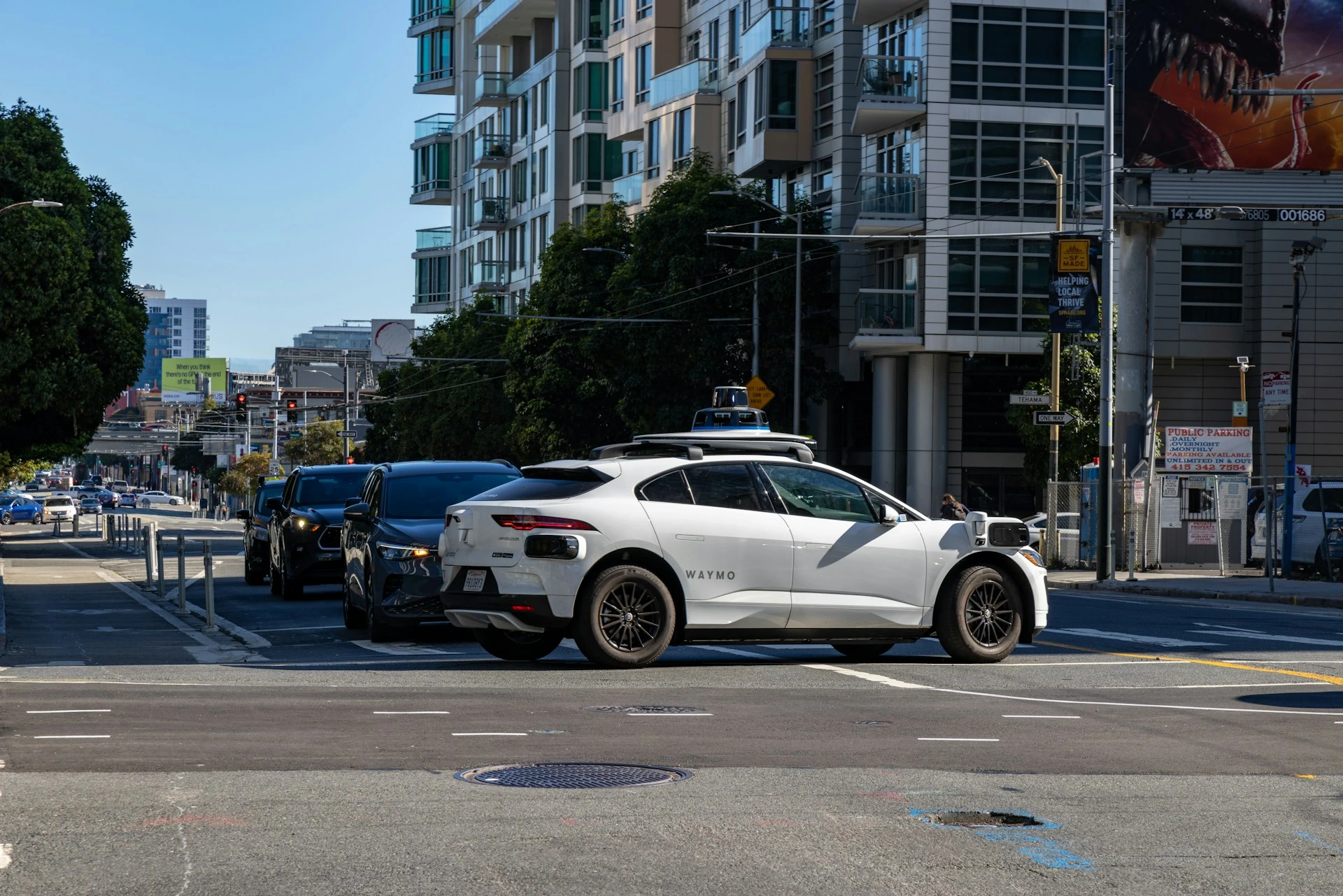
Photo by Hoseung Han on Unsplash
Waymo and Uber Launch Autonomous Ride-Hailing Service in Austin
- Written by Andrea Miliani Former Tech News Expert
- Fact-Checked by Sarah Frazier Former Content Manager
Waymo began offering robotaxi rides through Uber yesterday in Austin, Texas. Users in the area can experience the new technology at no extra cost.
In a Rush? Here are the Quick Facts!
- Waymo and Uber launched robotaxi rides in Austin, allowing users to experience autonomous vehicles at no extra cost.
- Riders booking UberX, Uber Comfort Electric, or Uber Green may be randomly matched with a Waymo self-driving car.
- Users can adjust their Uber app settings to increase the chance of riding a Waymo robotaxi.
According to the official announcement shared by Uber , riders who request certain services—UberX, Uber Comfort Electric, or Uber Green—may be randomly assigned to Waymo’s Jaguar I-PACE, a fully autonomous vehicle (AV). Those matched with a robotaxi will be notified and can choose to accept or decline the ride.
“We’re excited to introduce our customers to a future of transportation that is increasingly electric and autonomous,” states Uber’s announcement. “In Austin, Waymo rides will only be available on the Uber app.”
The ride-sharing company explained more details on what to expect from the experience. “Once the Waymo arrives, riders can unlock the vehicle, open the trunk, and start the trip – all from their familiar Uber app,” states the document. Users will get access to customer support 24/7 through the vehicle and the app.
Those eager to try the autonomous vehicle experience can adjust their Ride Preference through their Uber app settings and select “autonomous vehicles” to increase their chance of getting a Waymo robotaxi.
The area where the service will be available is located from Hide Park to Montopolis to Downtown. The companies expect to expand the area in Austin soon and offer the service in Atlanta as well.
Waymo and Uber announced the partnership to provide AV services in Austin and Atlanta in September last year. The robotaxi company also signed a contract with Hyundai in October and announced a new expansion plan in Japan in December.
However, Waymo has also faced challenges, and the public seems to have mixed feelings about the technology . A few months ago, one of Waymo’s robotaxis collided with a sidewalk delivery robot from Serve Robotics , raising concerns for pedestrians and users’ safety.
Image by Maverick Timotius, from Unsplash
Nvidia Chip Smuggling? Singapore Investigates Fraud Case
- Written by Kiara Fabbri Former Tech News Writer
- Fact-Checked by Sarah Frazier Former Content Manager
Singaporean authorities are investigating a potential fraud case involving servers containing Nvidia chips, which may have been exported to Malaysia before reaching an unknown final destination.
In a Rush? Here are the Quick Facts!
- Servers with possible Nvidia chips were exported from Singapore to Malaysia.
- Three people, including a Chinese national, were charged with fraud.
- U.S. authorities contacted to verify if exported servers contained restricted items.
Home Affairs and Law Minister K. Shanmugam disclosed the probe during a press briefing on March 3, following an anonymous tip-off, reported Reuters .
The investigation centers on servers supplied by U.S. firms Dell Technologies and Super Micro Computer to Singapore-based companies. These servers were later exported to Malaysia, but it remains uncertain whether Malaysia was the final stop.
Shanmugam stated that the servers “may contain Nvidia chips,” highlighting concerns that they could be subject to U.S. export restrictions.
The Business Times says that the case is linked to three individuals, including a Chinese national, who were charged with fraud in Singapore on February 27. Bloomberg suggests that the investigation might involve attempts to transfer Nvidia’s AI chips to the Chinese artificial intelligence company DeepSeek.
Singapore has reached out to U.S. authorities to verify whether the exported servers contained restricted items and has pledged cooperation in any joint investigation, as reported by Reuters. The case comes amid broader U.S. scrutiny of AI chip shipments to China.
Last year, reports surfaced that Chinese universities and research institutes had obtained Nvidia’s advanced chips embedded in Dell, Super Micro, and Gigabyte Technology server products, as noted by Reuters.
Bloomberg highlights that Shanmugam emphasized that the Singaporean investigation is independent and was not initiated at the request of any foreign government. However, Washington has been actively tightening restrictions on China’s access to advanced semiconductor technology through third-party countries.
In December, Nvidia reportedly asked Dell and Super Micro to audit Southeast Asian customers to verify their possession of Nvidia-powered servers, as reported by Bloomberg.
Singapore, a major trade hub for Nvidia, accounted for 18% of the company’s total revenue in its latest fiscal year, though actual shipments to the country contributed less than 2% of revenue. The city-state serves as a key invoicing center for Nvidia’s sales across Asia, as noted by Reuters.
The case casts a spotlight on the role of intermediaries in routing restricted AI chips to China. While Shanmugam refrained from explicitly linking the probe to DeepSeek or Chinese buyers, the broader context of U.S. concerns over chip smuggling remains a focal point.
The outcome of the investigation could have significant implications for Singapore’s position in the global semiconductor supply chain.
