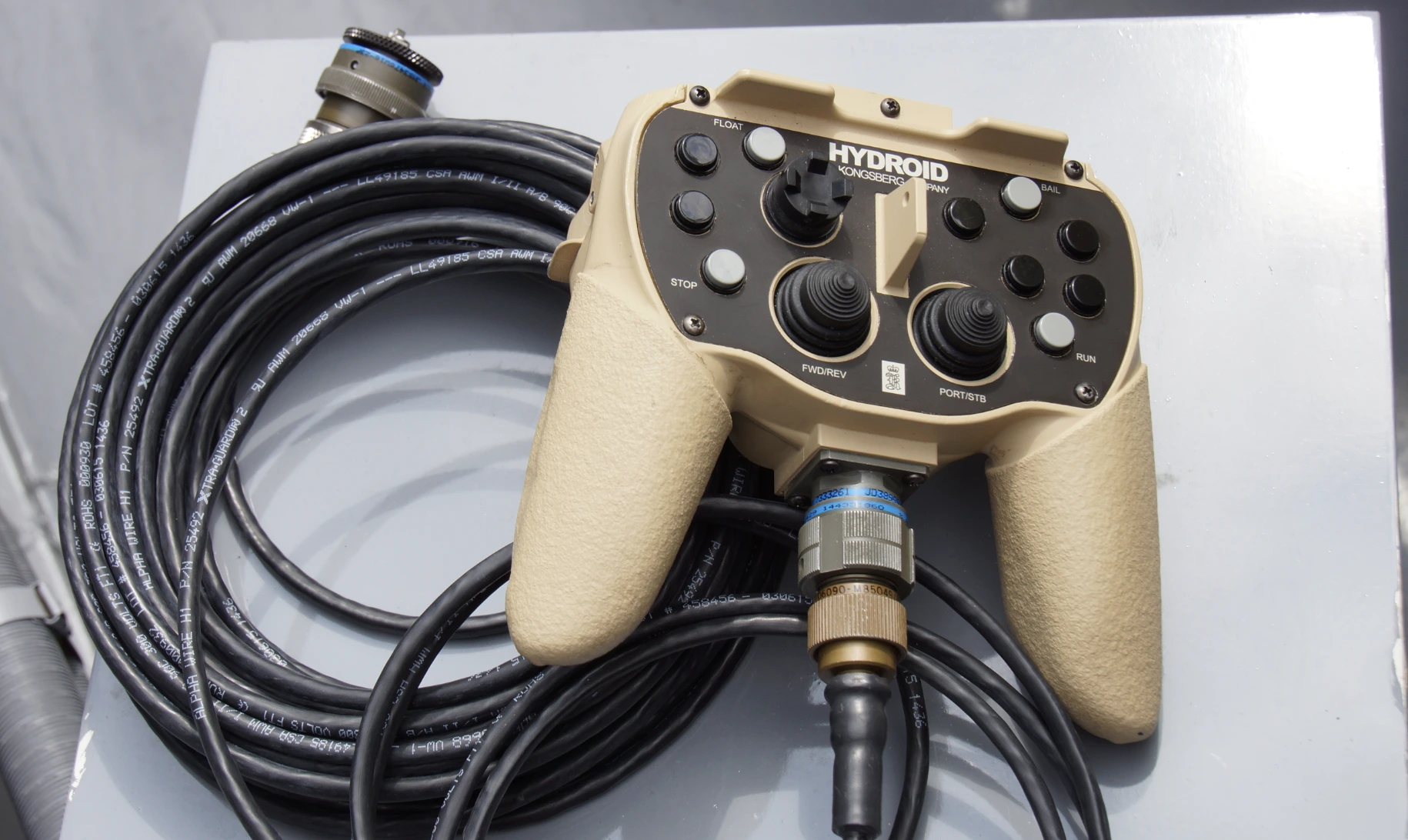
Image by Hunini, from Wikimedia Commons
Video Game-Style Controllers: The US Military’s New Weapon Of Choice
- Written by Kiara Fabbri Former Tech News Writer
- Fact-Checked by Justyn Newman Former Lead Cybersecurity Editor
In a Rush? Here are the Quick Facts!
- Pentagon integrates video game controllers for advanced weapons systems.
- Freedom of Movement Control Unit handsets are now primary control units.
- Xbox controllers have been used by the military for over a decade.
The US military has adopted video-game-style controllers as its preferred weapon control system, reports today WIRED .
After decades of relying on traditional buttons, switches, and toggles, the Pentagon is increasingly utilizing ergonomic controllers familiar to millions of potential recruits, according to WIRED.
Over the past few years, the Defense Department has integrated variants of the Freedom of Movement Control Unit (FMCU) handsets as the primary control units for several advanced weapons systems.
Imagery from the department’s Defense Visual Information Distribution System media hub shows the FMCU being used in various military applications, as noted by WIRED.
Among these systems is the Navy Marine Corps Expeditionary Ship Interdiction System (NMESIS) launcher, designed to fire the new Naval Strike Missile, crucial for the Marine Corps’ strategy in a potential conflict with China in the Indo-Pacific, reports WIRED.
The Army’s Maneuver-Short Range Air Defense (M-SHORAD) system, equipped with FIM-92 Stinger and AGM-114 Hellfire missiles, is also utilizing the FMCU as part of its anti-air capabilities in a possible clash with Russia in Eastern Europe, reports WIRED.
Furthermore, the Air Force employs the FMCU in the MRAP-based Recovery of Air Bases Denied by Ordnance (RADBO) truck, which uses lasers to clear explosive devices, notes WIRED.
The system is also being tested in the Humvee-mounted High Energy Laser-Expeditionary (HELEX) laser weapon system, according to WIRED.
The military’s use of video-game-style controllers isn’t entirely new, as service branches have experimented with commercial off-the-shelf console handsets for operating novel systems, notes WIRED.
For over a decade, the Army and Marine Corps have utilized Xbox controllers for various unmanned vehicles, including ground units and airborne drones, as reported by WIRED.
While the extent of FMCU’s usage in the military remains unclear, the Pentagon confirmed its use in several platforms, including the NMESIS, M-SHORAD, and RADBO systems, reports WIRED.
The adaptability and familiarity of these controls make them likely to persist in military applications, much like the joystick has in aviation since its inception, according to WIRED.

Image from Freepik
Meta Launches Movie Gen: AI-Powered Tool For Video Creation
- Written by Kiara Fabbri Former Tech News Writer
- Fact-Checked by Justyn Newman Former Lead Cybersecurity Editor
In a Rush? Here are the Quick Facts!
- Movie Gen generates up to 16-second videos from text prompts and photos.
- Concerns arise about potential job losses and misuse of AI-generated content.
- Meta plans to integrate Movie Gen into existing apps next year.
Meta announced today Movie Gen , a new AI-powered video generation. As reported by The New York Times (TNYT), Movie Gen can generate a new video clip, up to 16 seconds long, from a text prompt. The tool can also create audio and edit existing videos based on prompts.
The system also allows users to upload photos of themselves and turn them into moving videos. It produces 16-frame-per-second videos, though some videos may have flaws, as reported by TNYT.
The announcement follows OpenAI’s release of its text-to-video model, Sora , and ByteDance’s introduction of Jimeng AI . However, public access to Movie Gen is not yet available, as noted by The Verge .
Bloomberg adds that Movie Gen is currently accessible only to select internal employees and a few external partners, including filmmakers. However, Meta plans to integrate the product into its existing apps sometime next year.
Meta is holding off on releasing Movie Gen due to several factors, including the technology’s efficiency, reported Bloomberg. Currently, it takes too long—several minutes—to generate a video from a text prompt, which is impractical for general consumers, especially those using mobile devices, according to Bloomberg.
Additionally, Bloomberg notes that Meta is still addressing critical safety and responsibility concerns, such as ensuring that personalized videos can’t be used to create inappropriate or unflattering content involving others without their consent.
Additionally, experts have raised concerns that the technology could be used to cheaply create disinformation, making it harder to distinguish real content from fake online, TNYT notes.
TNYT argues that while companies like OpenAI have been cautious in releasing certain AI technologies due to these risks, Meta has been more open, arguing that the dangers are not as significant as they may appear.
Although major studios have long used artificial intelligence for creating advanced cinematic effects, recent developments in generative AI have sparked fears among actors that the technology could lead to job losses, according to The Washington Post (TWP).
This year, actors went on strike , expressing concerns that the unchecked use of AI could eventually replace the need for actors. While a new agreement grants actors control over AI voice replication , concerns still linger.
TWP reports that when asked about these concerns, Al-Dahle, Meta’s vice president of generative AI, stated that video generation tools will include a watermark to indicate they were created using AI.
Bloomberg reports that Meta executives are still deciding how to implement the integration of Movie Gen, with the goal of encouraging more users to create or edit video posts.
Bllomberg adds that the focus is on making the tool enjoyable for users, beneficial for creators, and boosting overall engagement across the apps. However, the specific product details are still being finalized.
WIRED reports that the details about what data Movie Gen has been trained on remain unclear. Meta stated that the models were trained using a combination of licensed and publicly available data sets.
The sources of this data—and the broader debate over what’s fair to scrape from the web—remain contentious issues in the development of generative AI tools, noted WIRED.
It’s still rare for companies to disclose what specific text, video, or audio clips were used to build major models, noted WIRED.
As the AI landscape evolves, the launch of Movie Gen raises important questions about the balance between innovation and ethical considerations, particularly in light of ongoing concerns about privacy, consent, and the potential for misuse.
The coming months will be crucial for Meta as it navigates these challenges while aiming to engage users in a new era of video creation.
