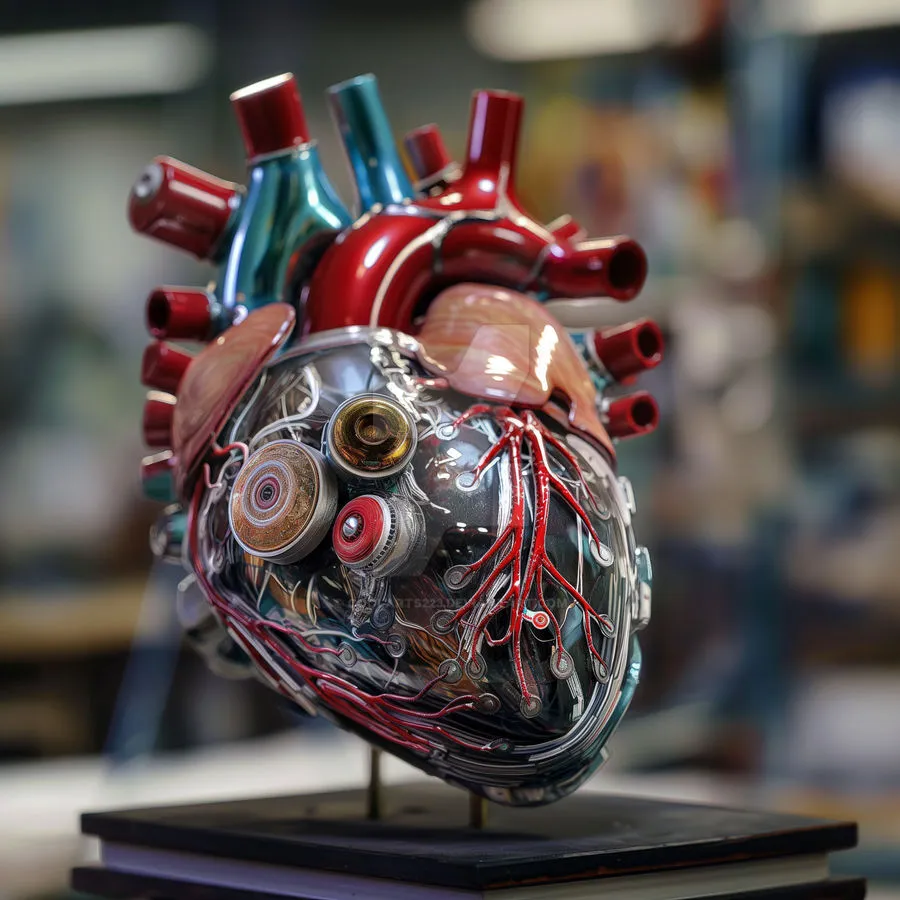
Image by Coolarts223, from Deviantart
The Texas Heart Institute Implants Artificial Heart
- Written by Kiara Fabbri Former Tech News Writer
- Fact-Checked by Justyn Newman Former Lead Cybersecurity Editor
On July 25, a team at the Texas Heart Institute (THI) successfully implanted the world’s first BiVACOR Total Artificial Heart (TAH) in a human patient. This groundbreaking procedure marks a significant advancement in the treatment of severe heart failure, potentially offering a bridge to transplant for patients facing long wait times.
The BiVACOR TAH is a revolutionary device compared to existing total artificial hearts. Unlike traditional models that rely on flexible diaphragms, the BiVACOR TAH utilizes a single, magnetically levitated rotor (a significant design simplification). This translates to several key advantages. Firstly, the absence of mechanical bearings and moving parts minimizes wear and tear, potentially extending the lifespan of the device. Additionally, the BiVACOR TAH is capable of delivering high blood flow rates, even during exertion, mimicking the performance of a healthy heart. Finally, the implant is small enough to fit most adult patients, promoting better patient comfort and mobility.
Daniel Timms , PhD, Founder and Chief Technology Officer of BiVACOR said , “I’m incredibly proud to witness the successful first-in-human implant of our TAH. This achievement would not have been possible without the courage of our first patient and their family, the dedication of our team, and our expert collaborators at The Texas Heart Institute. Utilizing advanced MAGLEV technology, our TAH brings us one step closer to providing a desperately needed option for people with end-stage heart failure who require support while waiting for a heart transplant. I look forward to continuing the next phase of our clinical trial.”
Heart failure is a major global health concern affecting an estimated 64 million people worldwide . Unfortunately, heart transplants, the current gold standard for severe cases, are limited due to donor availability.
The successful implantation of the BiVACOR TAH represents a major leap forward in cardiac care. This innovative technology holds immense promise for improving outcomes and extending the lives of patients suffering from heart failure.

Image by AFGE, from Wikimedia
Congresswoman Jennifer Wexton Delivers Historic AI-Generated Speech
- Written by Kiara Fabbri Former Tech News Writer
- Fact-Checked by Justyn Newman Former Lead Cybersecurity Editor
Congresswoman Jennifer Wexton (D-VA) made history on July 25 by delivering the first-ever speech on the House floor using an AI-generated voice, highlighting Disability Pride Month and her personal battle with Progressive Supranuclear Palsy (PSP).
Rep. Jennifer Wexton , diagnosed with PSP last year, used an AI voice model to address the House of Representatives. This technology, developed by ElevenLabs , enabled her to speak clearly despite her condition. Wexton’s speech emphasised her ongoing fight for disability rights, a cause she has championed throughout her career.
“I hope that when people see me continuing to do all I can to keep living my life and doing this job I love as best I can, they understand and appreciate the courage, resilience, and spirit that so many Americans of differing abilities demonstrate each and every day. I hope I can be a voice — even an AI voice — for Americans facing accessibility challenges and other disabilities, ” said Wexton in her speech.
ElevenLabs, a speech synthesis company, approached Representative Wexton’s office with the goal of developing a voice model that accurately replicates her speaking voice, rather than the generic sound typically associated with text-to-speech technology.
“Our technology gives individuals who have lost their voice the ability to speak as they once did, with the emotion and passion they feel, and we hoped to help the Congresswoman do just that.” NPR reports Sam Sklar of ElevenLabs saying.
The use of AI to recreate Wexton’s voice represents a significant advancement in assistive technology, offering new opportunities for individuals with speech impairments. However, it also brings attention to the broader implications of AI in society. While AI can empower those with disabilities, it also poses risks, such as the potential for misuse in fraud or misinformation.
Wexton’s experience illustrates both the promise and perils of AI. Her successful use of the technology to maintain her voice in Congress serves as an inspiring example, but she also advocates for stringent regulations to prevent abuse.
“It is humanizing and it is empowering. It can also be dangerous […] I still believe that the dangerous potential of AI technology must be better understood and steps must be taken to prevent abuses of the technology like deepfakes from proliferating and part of that falls on lawmakers like us in Congress” AP reports her saying.
In conclusion, Wexton’s historic speech not only marks a milestone in the use of AI for accessibility but also ignites a necessary conversation about the ethical use of emerging technologies. As AI continues to evolve, balancing its benefits with potential risks will be crucial in shaping a future where technology serves humanity responsibly.
