The Apple-Only Arc Browser Finally Arrives on Windows
- Written by Shipra Sanganeria Cybersecurity & Tech Writer
- Fact-Checked by
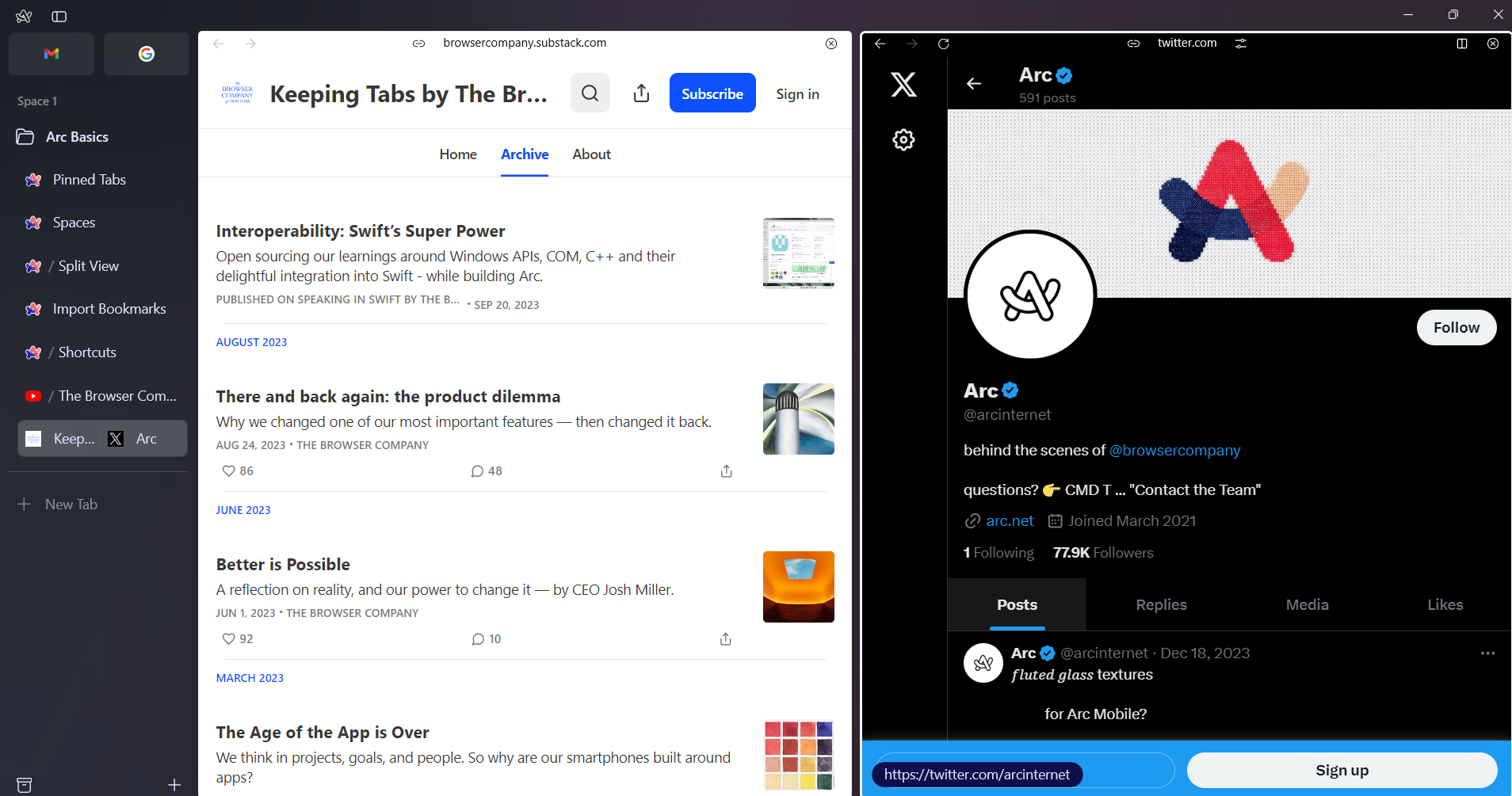
Arc has been popular amongst Apple users since its first release in April 2022, and nearly 2 years later, it finally launched its Windows browser .
Designed initially for Mac and iOS, the popular browser from The Browser Company has had its Windows version in beta since December 2023 .
The impetus for the company behind Arc stemmed from strong demand and the opportunity to tap into the Chrome and Edge user market. This led the company to design a browser that would transform how browsers have been traditionally utilized for the past several years.
“Arc really is just calming and keeps you organized,” Hursh Agrawal, co-founder of The Browser Company, said in an interview with The Verge .
Since their launch, Chrome and Edge users have been accustomed to having their tabs visible up on the top, but Arc promises to be different, providing a more clutter-free experience for users. “It helps you handle your tasks during the day better,” Hursh says.
With a unique interface layout and features like a collapsible sidebar with vertical tabs and bookmarks. There’s also a split view that allows two tabs in a single window, picture-in-picture, and more features that help streamline organization within a browser.
The hope is that Arc manages to emulate the success of Chrome , which witnessed a migration of users from Internet Explorer and Firefox over a decade ago.
“I saw the transition at Google when people went from everybody using Internet Explorer and Firefox to suddenly people using Chrome,” Darin Fisher, software engineer at The Browser Company, said in an interview with The Verge.
The creators not only believe that Arc will fill a gap current popular browsers have, but will also become “the operating system for the internet.”
On top of this, Arc for Windows has been built using Apple’s Swift development language and is open-source. In doing this, The Browser Company also hopes that developers will more easily be able to build Windows-based applications using Swift, possibly creating an easier crossover between the two rival operating systems.
Despite its impressive feature lineup, the browser still needs to upend the strong user market of Chrome. Since its April 30 launch, Arc has been introducing new features every Thursday and resolving bugs and other issues based on user feedback .
“The experience [of Arc on Windows] is good, but it’s not there yet, and we’re going to ship every week to get it to a place where it’s unbelievable,” said Agrawal to The Verge.
Currently, the software is only available to download for Windows 11, with a Windows 10 version slated for later release.

Bitcoin Trader Loses Nearly $70 Million Through Address Poisoning Scam
- Written by Andrea Miliani Former Tech News Expert
- Fact-Checked by
A cryptocurrency trader lost around $70 million worth of Wrapped Bitcoin (WBTC) through an “address poisoning” scam on May 3. The assets were converted into Ethereum (ETH) and distributed into 400 crypto wallets just a few days later.
According to CoinDesk , multiple blockchain security firms have already confirmed the fraud and the transactions related to this case.
The scammer, imitating a previous transaction, made a 0.05 ether (ETH) transaction to the victim, from a similar wallet address, confusing the trader and tricking them into sending 1,155 WBTC—97% of their assets— to the fake address. The strategy fits perfectly into the modus operandi of this type of scam described by Transak , the Web3 trading platform.
“Scammers make a crypto address that looks almost like yours. They send a small amount to your wallet, hoping you’ll accidentally use their address for your next big transaction.”
Certifik, the blockchain security firm, shared an image and information of the transaction on X through its alerts account CertiK Alert.
“Our system has detected a transfer of 1,155 WBTC (~$69.3m) to an address linked to address poisoning. EOA 0xd9A1 mimicked a transfer of 0.05 ETH which led the victim to send the funds to the wrong address.”
A research team from the blockchain security firm SlowMist is currently investigating the case and shared a report on Medium . The investigation reveals that the hacker generated a transfer address that was identical to the victim’s actual one in the first four and last six digits. The day after making the transaction the victim wrote to the scammer on the blockchain.
“You’ve won, brother. You can keep 10% and return the 90%. We can act like nothing happened. We both know $7 million is enough to live very comfortably, but $70 million will keep you up at night,” they said, according to the Medium report.
The victim sent more messages to the hacker but didn’t get a response. The hacker turned the stolen WBTC into ETH and waited six days to transfer the money into approximately 400 crypto wallets, making it harder for anyone to trace the assets.
The investigations continue, but there are no guarantees that the victim will get their money back. Amid the current crypto market turbulence , users must stay vigilant, informed, and extremely careful when transferring funds.
