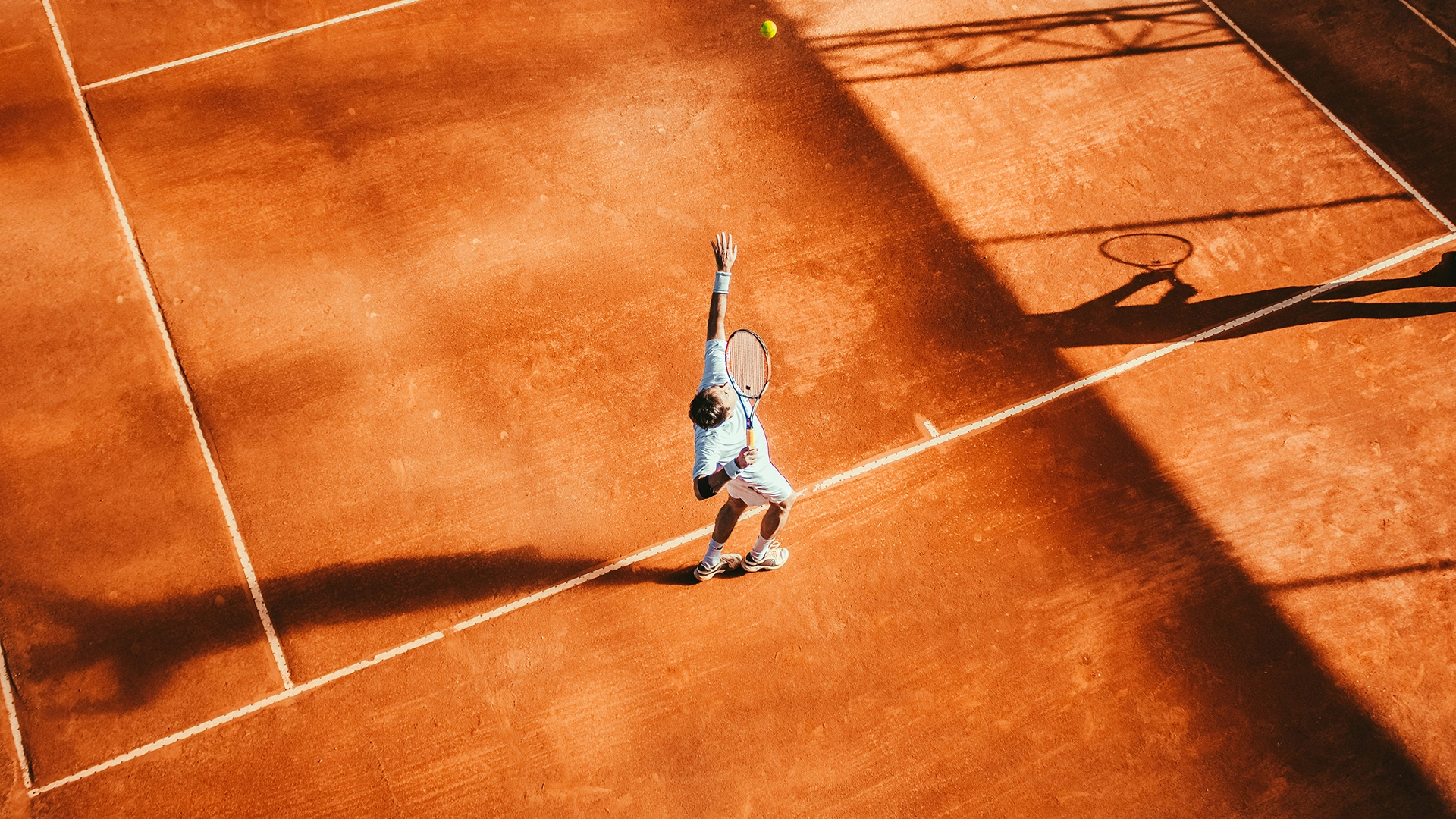
Image by Moises Alex, from Unsplash
Tennis Players Protest ELS Calls During Madrid Open Clay Matches
- Written by Kiara Fabbri Former Tech News Writer
- Fact-Checked by Sarah Frazier Former Content Manager
Alexander Zverev sparked controversy at the Madrid Open after challenging an electronic line call during a clay match against Davidovich Fokina.
In a rush? Here are the quick facts:
- Zverev received a code violation for using his phone in court.
- Hawk-Eye’s system accuracy was questioned due to clay surface inconsistencies.
- Other players like Azarenka and Lys also challenged ELS decisions.
Tennis star Alexander Zverev has reignited the debate around electronic line-calling systems (ELS) after a controversial point during his Madrid Open match on clay against Spain’s Alejandro Davidovich Fokina, as first reported by The New York Times .
Zverev observed the backhand which barely touched the edge of the court while the automated system failed to make a call so the point counted as in. He immediately asked chair umpire Mohamed Lahyani to come down and inspect the ball mark left on the clay. “The machine is not working. Look at this mark … Don’t overrule it, please come down,” Zverev said, as reported by The Times.
Lahyani refused, explaining that under the current system, once the ELS makes a call, the physical ball mark is no longer used. The Times reports that Zverev, frustrated, took out his phone to take a picture of the spot which he later posted on Instagram. He received a code violation for this action, the same penalty that Aryna Sabalenka received days earlier in Stuttgart.
On clay, balls leave visible marks, traditionally considered the most reliable way to judge a shot. However, with the rise of ELS, human line judges are being replaced.
Systems like Hawk-Eye now use multiple cameras and predictive technology to decide whether a ball is in or out, with claimed accuracy down to three millimeters. But even this can be affected by court conditions, such as how dry or thick the clay is, as noted by The Times.
While Hawk-Eye says its system is ready for clay, some players aren’t convinced. Victoria Azarenka and Eva Lys also posted photos questioning calls made during the Madrid Open. Arthur Fils, after disagreeing with several points, even called for a return to line judges.
This ball in or out? pic.twitter.com/Y1dNViuO5K — victoria azarenka (@vika7) April 25, 2025
ELC said its in… it was a wide serve. Thoughts ? 😀😀😀😀😀😀😀😀 pic.twitter.com/DIJAVemGue — Eva Lys (@evalys_) April 25, 2025
“Clay is a very different surface — probably the most difficult surface to work on,” said ATP supervisor Cedric Mourier, noting how reading clay marks can be subjective, as reported by The Verge .
Despite the drama, Zverev went on to win the match in a close 2-6, 7-6(3), 7-6(0) victory. He now moves forward to face either Francisco Comesana or Francisco Cerundolo.
Photo by appshunter.io on Unsplash
Duolingo Becomes An AI-First Company, Replacing Contractors With AI
- Written by Andrea Miliani Former Tech News Expert
- Fact-Checked by Sarah Frazier Former Content Manager
Duolingo announced this Monday that it has officially become an “AI-first” company, gradually replacing contractors with AI capable of handling their work. The company’s CEO, Luis von Ahn, sent an email to employees that was later shared on Duolingo’s LinkedIn account.
In a rush? Here are the quick facts:
- CEO Luis von Ahn announced that Duolingo is officially an AI-first company.
- The company will gradually transition from using human contractors to relying on AI capable of performing the work.
- Von Ahn compared the current AI wave to the mobile wave of 2012 and emphasized the need to adopt and embrace the technology quickly.
According to the post , the new measures reflect the fast pace of AI development and the need to adopt emerging technologies quickly. Von Ahn compared the current AI wave to the mobile wave of 2012.
“In 2012, we bet on mobile,” wrote von Ahn. “While others were focused on mobile companion apps for websites, we decided to build mobile-first because we saw it was the future.”
von Ahn explained that they need to develop a “massive amount of content” and that by using AI, they’ve been able to do work that would have taken decades to do manually, including new features like the AI-powered feature Video Call that allows users to interact in real-life conversations with one of Duolingo’s animated characters. “For the first time ever, teaching as well as the best human tutors is within our reach,” wrote the CEO.
Duolingo will be making major changes, including gradually letting go of contractors if the work can be done with AI, rethinking how they work, and including more automation, even if the technology isn’t as good as expected. “We can’t wait until the technology is 100% perfect,” states the email and highlights the urgency for new measures.
“Duolingo will remain a company that cares deeply about its employees,” wrote von Ahn. “This isn’t about replacing Duos with AI. It’s about removing bottlenecks so we can do more with the outstanding Duos we already have.”
First Shopify. Now Duolingo. If you’re a “digital native business” (ie born in the cloud, born on mobile – think Pinterest, Airbnb, Stripe) and haven’t gotten the memo, here is the literal memo. pic.twitter.com/0dFhgJJLFP — Allie K. Miller (@alliekmiller) April 28, 2025
Just a few days ago, Shopify’s CEO also announced that they will prioritize AI and that they won’t hire new employees unless it can be proved that AI can’t do it.
