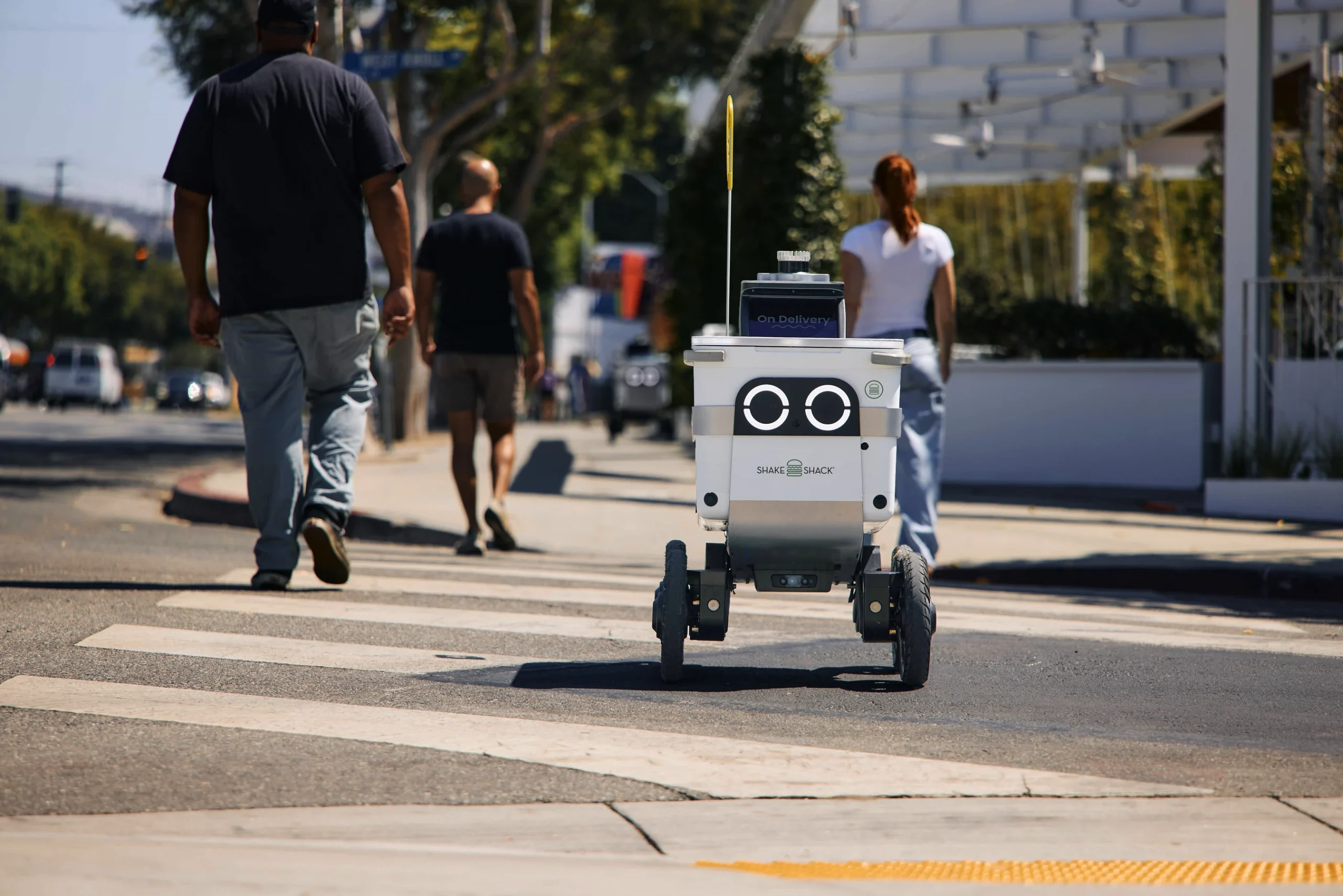
Image courtesy of Serve Robotics
Shake Shack And Serve Robotics Partner To Deliver Food With Robots In Los Angeles
- Written by Andrea Miliani Former Tech News Expert
- Fact-Checked by
Fast food chain Shake Shack and AI-powered delivery robots company Serve Robotics announced this Wednesday a new partnership to deliver food in Los Angeles through the Uber Eats Platform. Serve’s autonomous delivery robots will take care of customers’ orders from selected Shake Shacks in the city in the following days.
“We are excited to add another national merchant like Shake Shack to our platform, a partnership made possible through the relationship we have built with Uber Eats across tens of thousands of successful deliveries,” said Touraj Parang, President and COO of Serve Robotics.
Parang also announced that Serve expects to deploy 2,000 robots across the United States by 2025. Los Angeles is not the first city where these sidewalk robots have been used for Uber deliveries. In April, Uber and Wayno announced their first robot delivery service in Phoenix, Arizona.
Through the press release, the companies promised customers that the robots had been optimized for fast deliveries, avoiding obstacles in their GPS-planned routes, and that orders should arrive hot—or cold—and fresh. “And there’s no need to tip the robot!” states the document.
Serve Robotics has shared a short video on X featuring the four-wheeled robot with a modern cart design to promote the new service in Los Angeles. “Serve is now on delivery for Shake Shack! Select Shake Shack customers in the Los Angeles area may receive their next Uber Eats order via Serve Robotics.”
Serve is now on delivery for @shakeshack ! Select Shake Shack customers in the Los Angeles area may receive their next @UberEats order via @ServeRobotics 🤖🍔🍟 👉 Learn more: https://t.co/OYECUwmcAz pic.twitter.com/o44nTpZacP — Serve Robotics (@ServeRobotics) August 14, 2024
Los Angeles residents will be seeing multiple AI-powered independent technologies around the city as Waymo has also deployed self-driving vehicles in the city and recently got approval from regulators to use robotaxis in local freeways .
Image by Jcomp, from Freepik
New Research Exposes Security Flaws In Popular Digital Wallets
- Written by Kiara Fabbri Former Tech News Writer
- Fact-Checked by Justyn Newman Former Lead Cybersecurity Editor
A research paper published today by the University of Massachusetts Amherst has revealed significant security vulnerabilities in popular digital wallets like Apple Pay, Google Pay, and PayPal. The study highlights how these technologies, projected to be used by over 5.3 billion people by 2026, could be compromised because of outdated authentication methods that place convenience before security.
The university announcement also explains that the researchers have identified a flaw in how banks handle stolen cards. Banks typically block the physical card but fail to address transactions through digital wallets, where the token system does not require re-authentication after the card is replaced.
As a result, attackers can still use stolen card details for purchases even after the victim has received a new card. This exposes a critical security gap that needs to be addressed to protect against fraudulent transactions.
Taqi Raza, one of the paper’s authors, states in the announcement, “Any malicious actor who knows the [physical] card number can pretend to be the cardholder, […] The digital wallet does not have sufficient mechanism to authenticate whether the card user is the cardholder or not.”
Furthermore, the study reveals that attackers can exploit these digital wallets through various means. First, they can add a victim’s bank card to their own wallet by bypassing the authentication agreement between the wallet and the bank.
Second, they exploit the inherent trust between the wallet and the bank to bypass payment authorization. Third, attackers can manipulate payment types to circumvent access control policies, allowing them to make unauthorized purchases despite the card being reported as stolen.
The study examined vulnerabilities in major U.S. banks and digital wallet apps, revealing that even after banks were notified, the issues persist. Researchers found that new card details are linked to the old virtual token without re-authentication, enabling ongoing fraudulent activity.
To address these issues, the study proposes several countermeasures. One major recommendation is to replace outdated one-time password (OTP) systems with more secure multi-factor authentication (MFA) methods.
Additionally, the study suggests implementing continuous authentication for token management to enhance security. Currently, payment tokens remain valid indefinitely after initial authentication. The recommendation is for banks to use periodic re-authentication and token refreshes, especially after critical events like card loss.
Finally, the research recommends improving transaction authorization by analyzing transaction metadata, such as time and frequency, to distinguish between one-time and recurring transactions. This would help prevent misuse of transaction labels and ensure transactions match their intended types and amounts.
