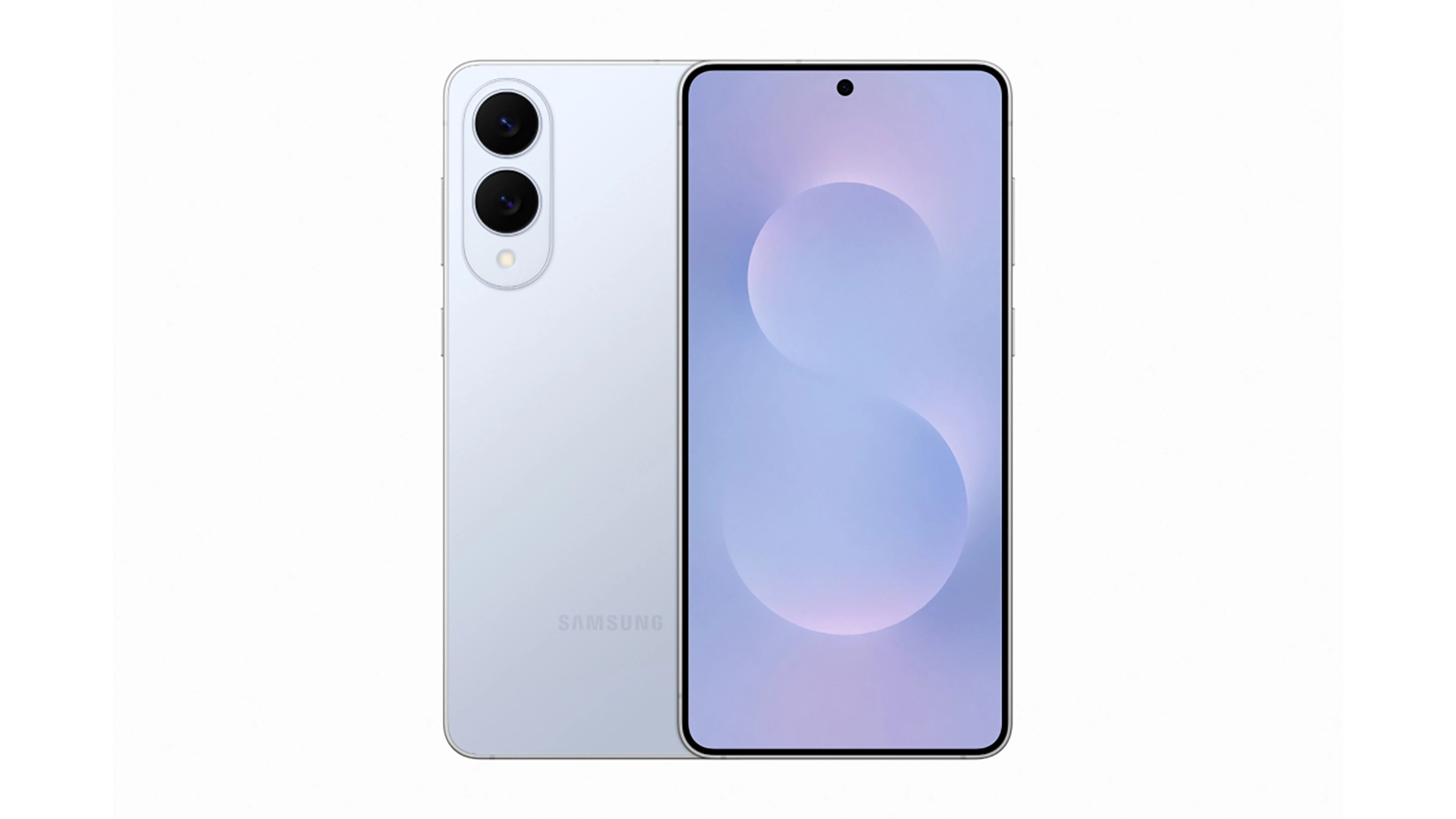
Photo courtesy of Samsung
Samsung Launches Galaxy S25 Edge, Its Slimmest Flagship Smartphone
- Written by Andrea Miliani Former Tech News Expert
- Fact-Checked by Sarah Frazier Former Content Manager
Samsung released its new Galaxy S25 Edge device this Tuesday. The smartphone is the slimmest flagship model the company has launched to date, featuring advanced AI capabilities and positioned to compete with Apple’s upcoming release.
In a rush? Here are the quick facts:
- Samsung launches its thinnest flagship model, the Galaxy S25 Edge.
- The new device is 5.8 mm thick, weighs 163 grams, and includes a Snapdragon Qualcomm chip as well as AI features.
- The Galaxy S25 Edge rates start at $1,099, and sales will begin on May 23 in South Korea.
According to the press release, the new device is 5.8mm thick, weighs 163 grams, and includes a Galaxy AI-enabled camera, as well as a customized Qualcomm Snapdragon 8 Qualcomm chip . Customers can choose from multiple colors—Titanium Icyblue, Titanium Jetblack, and Titanium Silver—and two storage capacities: 256 GB and 512 GB.
“Galaxy S25 Edge is more than a slim smartphone,” said TM Roh, President and Acting Head of the Device eXperience (DX) Division at Samsung Electronics. “The superior engineering that brought this revolutionary smartphone to life illustrates a commitment to overcoming barriers that helps Galaxy deliver truly unexpected premium experiences for people around the world.”
Ready to go beyond slim? 🩵 like this post for updates and join us on May 13, 2025 to check out the slimmest Galaxy S Series ever. #GalaxyAI #GalaxyS25 Edge pic.twitter.com/TSfBdWWxJq — Samsung Mobile (@SamsungMobile) May 7, 2025
The company highlighted the new Galaxy S25 Edge’s camera, which features a 200MP wide lens with a 40% brightness improvement compared to previous Galaxy models, as well as a 12MP ultra-wide sensor with autofocus. The device also offers AI-powered photo editing tools, including Drawing Assist and Audio Eraser.
According to Reuters , experts say Samsung strategically launched the new flagship model today before Apple released its latest model, which is expected to be thinner than previous versions and include special AI-powered features.
“By releasing the product a few months ahead, Samsung could inflict some impact on Apple and attract consumers looking for thinner smartphones. It appears to be a calculated decision to capture that segment of demand,” said Ryu Young-ho, a senior analyst at NH Investment & Securities, to Reuters.
The new device will be available for sale starting at $1,099 on May 23 in South Korea and on May 30 in the United States. Samsung plans to expand Galaxy S25 Edge sales to 30 countries, including those in Europe and China.
Samsung released its Galaxy S25 series —Galaxy S25 Ultra, Galaxy S25+, and Galaxy S25—in January at the Samsung Galaxy Unpacked 2025 event in California.
Image by Joseph Greve, from Unsplash
Ransomware Can Now Infect Your Processor
- Written by Kiara Fabbri Former Tech News Writer
- Fact-Checked by Sarah Frazier Former Content Manager
A cybersecurity expert has revealed that ransomware can now be installed directly onto a computer’s CPU, bypassing nearly all traditional forms of protection.
In a rush? Here are the quick facts:
- Ransomware can now run directly from CPU microcode, bypassing all defenses.
- Expert Christiaan Beek developed a working proof-of-concept.
- Industry focus on AI overlooks core cybersecurity hygiene.
Christiaan Beek, a senior threat analyst at Rapid7, demonstrated a proof-of-concept (PoC) that hides ransomware in a chip’s microcode—the low-level code that controls processor behavior, as first reported by The Register .
The idea came from a serious vulnerability in AMD’s Zen processors, first uncovered by Google researchers. The flaw allowed attackers to replace the CPU’s random number generator with malicious code that always selects the number 4, as reported by The Register.
“Coming from a background in firmware security, I was like, woah, I think I can write some CPU ransomware,” Beek told The Register. Beek stated that he tested this method himself, and worked.
Although Beek has no intention of releasing the code, he described the breakthrough as “fascinating.” He warned that once ransomware reaches the CPU level or firmware, it can completely bypass antivirus software, firewalls, and other standard security tools.
The Register notes that tis type of threat isn’t just theoretical. Criminals have already been developing similar techniques. Leaked 2022 chat logs from the Conti ransomware gang revealed developers were working on ransomware that infects UEFI firmware—software that loads before the operating system.
Beek criticized the industry’s focus on trendy tech like AI and machine learning while basic security flaws go unaddressed. “We should not be talking about ransomware in 2025—and that fault falls on everyone,” he said to The Register.
“It’s a high-risk vulnerability, or a weak password, or we haven’t deployed multi-factor authentication. That is frustrating,” he added.
His message to companies is clear: focus less on buzzwords and more on cybersecurity basics. Otherwise, the threats will only get worse.
