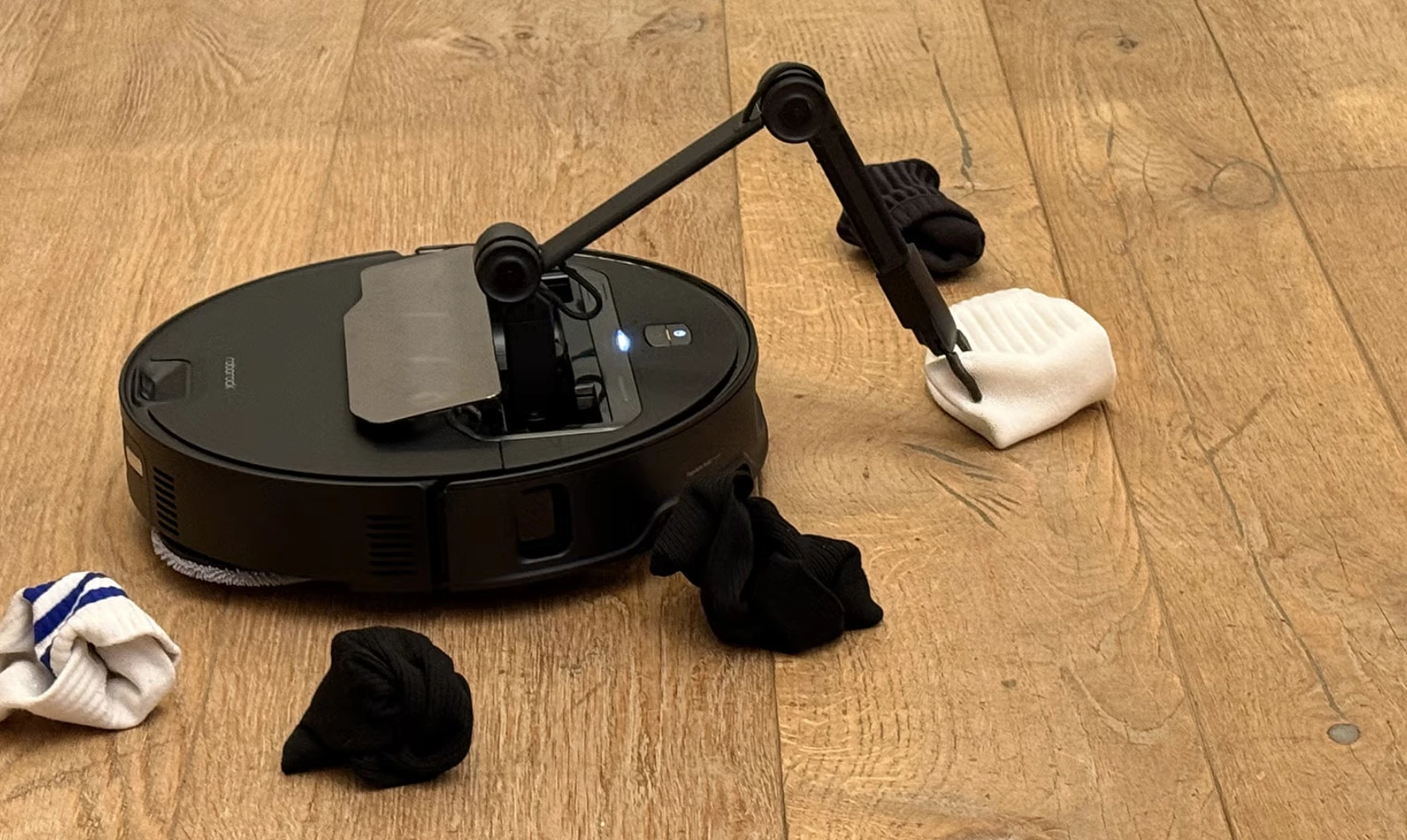
Image from Trusted Reviews
Roborock’s Z70 Vacuum Features Robotic Arm To Clear Obstacles
- Written by Kiara Fabbri Former Tech News Writer
- Fact-Checked by Justyn Newman Former Lead Cybersecurity Editor
Roborock has introduced its latest vacuum model, the Saros Z70, which features a robotic arm and enhanced navigation capabilities.
In a Rush? Here are the Quick Facts!
- The Roborock Z70 introduces a robotic arm to move small obstacles during cleaning.
- The robotic arm can handle objects weighing up to 300 grams.
- The Roborock Z70 will be priced at $1,600 and ships on February 10.
The Z70’s robotic arm, which unfolds from the top of the vacuum, can extend and twist to move objects weighing under 300 grams, such as small items of laundry, as reported by TechCrunch .
After completing a basic cleaning pass, the robot returns to interact with these objects, moving them to areas it has already cleaned. The arm is equipped with an onboard camera and sensors that help it navigate and identify obstacles, as reported by TechCrunch.
The Verge notes that the Z70’s cleaning process begins by detecting and marking any items it can lift during its first run. Once the floor is cleared, it circles back to move the items and clean the previously obstructed areas.
The Verge says that system allows for a third run, where it can place the items in a designated spot, such as a laundry basket or near a closet, based on the user’s preferences in Roborock’s app.
In addition to the robotic arm, the Z70 features Roborock’s StarSight Autonomous System 2.0 , a navigation system that uses machine learning and advanced sensors to detect and map up to 108 different obstacles in a home, as reported by The Verge.
The system can identify specific objects, like a purse or teddy bear, and the vacuum can even be programmed via the Z70’s app to return and pick up these objects, demonstrating the arm’s role in interacting with the environment.
The Verge also notes that the Z70 builds on Roborock’s previous models, incorporating advanced technologies such as 3D time-of-flight sensors, RGB cameras, and machine learning for improved navigation.
The system also includes VertiBeam, a laser-powered obstacle avoidance feature that enhances the robot’s ability to clean around cables and irregularly shaped furniture, as reported by The Verge.
Despite these advancements, TechCrunch notes that the Z70 comes with a significant price tag of $1,600. While the robotic arm marks a significant advancement in vacuum technology, its widespread adoption remains uncertain due to the high cost compared to traditional models.
The Verge previewed the Saros Z70 ahead of its CES 2025 launch, and confirmed that the arm functions as expected, though it operates slowly. During the demo, it took about a minute to pick up and move each sock. Furthermore, the arm is limited to handling items under 300 grams.
Roborock has stated that additional items will be supported in the future, but hasn’t committed to increasing the weight limit, says The Verge. The fact that manually lifting socks might be more convenient could deter people from seeing the utility of such an expensive vacuum.
Additionally, the inclusion of built-in cameras and AI raises potential cybersecurity concerns for smart vacuum owners .
As reported recently by Medium , smart home devices are vulnerable to hackers, leading to data breaches, device hijacking, and network compromises. These threats can result in unauthorized access to personal data and physical security systems.
To mitigate these risks, Medium recommends securing networks, regularly updating devices, and using strong authentication practices. Manufacturers must prioritize cybersecurity when designing these devices.

Image by TechCrunch, from Flickr
Virtual Employees Could Enter Workforces This Year, OpenAI CEO Predicts
- Written by Kiara Fabbri Former Tech News Writer
- Fact-Checked by Justyn Newman Former Lead Cybersecurity Editor
Artificial intelligence agents, capable of autonomously performing tasks, could join workforces as early as this year, transforming business operations, according to OpenAI CEO Sam Altman.
In a Rush? Here are the Quick Facts!
- OpenAI’s AI agent “Operator” will automate tasks like writing code and booking travel.
- McKinsey predicts 30% of U.S. work hours could be automated by 2030.
- Altman expresses confidence in building artificial general intelligence (AGI) and superintelligence.
In a blog post published Monday, Altman stated that AI-powered virtual employees could revolutionize the company output by taking on tasks traditionally handled by humans. The Guardian points out that Microsoft, OpenAI’s largest backer, has already introduced AI agents, with consulting giant McKinsey among the first to adopt the technology.
“We believe that, in 2025, we may see the first AI agents “join the workforce” and materially change the output of companies. We continue to believe that iteratively putting great tools in the hands of people leads to great, broadly-distributed outcomes,” Altman wrote in the blog post.
OpenAI is reportedly set to launch an AI agent, codenamed “ Operator ,” later this month. The tool is expected to automate tasks such as writing code or booking travel on behalf of users. This move follows the release of Microsoft’s Copilot Studio , Anthropic’s Claude 3.5 Sonnet , Meta’s AI agents with physical-like bodies , and Salesforce’s new AI features in Slack .
McKinsey is already developing an agent to streamline client inquiries, including scheduling follow-ups. The firm projects that by 2030, up to 30% of work hours across the U.S. economy could be automated, as noted by The Guardian.
Microsoft’s head of AI, Mustafa Suleyman, has also expressed optimism about agents capable of making purchasing decisions. In an interview with WIRED he described witnessing “stunning demos” of AI completing transactions independently but acknowledged challenges in development. Suleyman predicted these advanced capabilities could emerge “in quarters, not years.”
Altman’s blog also touched on OpenAI’s confidence in creating artificial general intelligence (AGI)—AI systems that surpass human intelligence. “We are now confident we know how to build AGI as we have traditionally understood it,” he wrote.
Looking beyond AGI, Altman outlined OpenAI’s ambitions for “superintelligence,” which he described as tools that could significantly accelerate scientific discovery and innovation.
“Superintelligent tools could massively accelerate scientific discovery and innovation well beyond what we are capable of doing on our own, and in turn massively increase abundance and prosperity,”Altman wrote, expressing enthusiasm for a future where such advancements reshape human potential.
The rapid growth of AI in the workforce has broad implications for business productivity and the economy. However, as AI agents evolve, new security risks emerge.
A recent survey, published by Medium , highlighted vulnerabilities such as unpredictable multi-step user inputs, internal execution complexities, variability in operational environments, and interactions with untrusted external entities.
Unclear or incomplete user inputs can trigger unintended actions, while AI agents’ internal processes often lack real-time observability, making security threats hard to detect. Furthermore, agents operating across diverse environments may exhibit inconsistent behaviors, and trusting external entities without proper verification can expose agents to attacks.
These challenges underline the need for robust security frameworks to protect AI agents and ensure their safe deployment in real-world scenarios.
