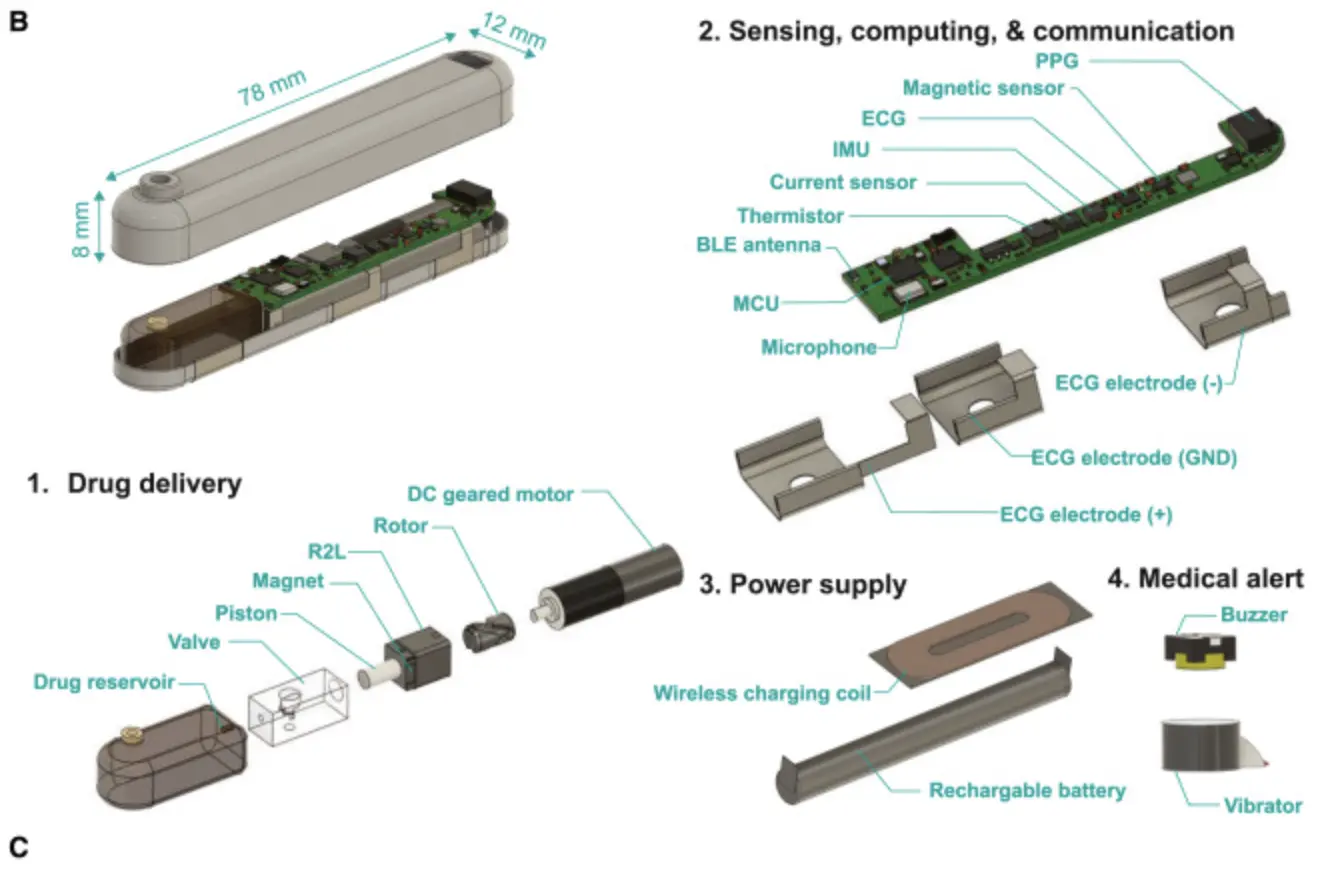
Screenshot of a figure from the research article, DOI: 10.1016/j.device.2024.100517.
Researchers Develop An Implantable Sensor To Combat Opioid Overdoses
- Written by Kiara Fabbri Former Tech News Writer
- Fact-Checked by Justyn Newman Former Lead Cybersecurity Editor
Researchers at MIT and Brigham and Women’s Hospital have developed an implantable device aimed at addressing the opioid overdose crisis. This small, gum-sized device, implanted under the skin, is designed to monitor vital signs and deliver naloxone, an opioid antidote, in the event of an overdose.
The study published on August 14 in the journal Device showcases the functionality of this new device. The implanted robotic device aims to overcome the limitations of current overdose reversal systems.
While naloxone is effective in reversing overdoses, the research paper reported that with current systems, less than 5% of overdose victims survive. This low survival rate is often due to delays or the absence of first responder intervention. Contributing factors include low user compliance with existing reversal systems, inaccurate overdose detection, and slow drug delivery.
To address these limitations, the researchers developed a subcutaneously implantable robotic first responder . The device continuously monitors vital signs, and employs an algorithm to detect opioid overdoses based on cardio-respiratory patterns. In case of an overdose, the device rapidly delivers a 10mg dose of naloxone in under 10 seconds.
The study trials demonstrated the system’s effectiveness in reviving 96% of overdosed pigs within 3.2 minutes. Additionally, the device was effective in distinguishing overdoses from other conditions, such as sleep apnea.
These results highlight the potential of this implantable technology to significantly improve survival rates.
“This could really address a significant unmet need in the population that suffers from substance abuse and opiate dependency to help mitigate overdoses, with the initial focus on the high-risk population,” said Giovanni Traverso, a senior author of the study, in an MIT News Announcement .
As reported in the MIT News Announcement, the researchers aim to further refine the device to enhance user comfort and integration. The next steps involve testing the device in human trials, which could commence within the next three to five years. They also plan to address the device’s miniaturization and battery life to ensure it remains effective over extended periods.
Image created with Openart.ai
Brain Implant Restores Speech In ALS Patient
- Written by Kiara Fabbri Former Tech News Writer
- Fact-Checked by
A new brain-computer interface (BCI) has allowed a man with advanced ALS to regain his ability to communicate through a brain implant. The findings of this case were published yesterday in the New England Journal of Medicine.
This new technology converts brain signals into text on a computer screen, which can then be converted using text-to-speech technology with up to 97% accuracy. According to UC Davis Health —the developers of the interface—these results make it the most accurate system of its kind to date.
This BCI was implanted into the brain of Casey Harrell, a 45-year-old ALS patient who had lost most of his ability to speak due to the disease’s progression. ALS progressively impairs nerve cells responsible for movement, leading to a loss of muscle control and, ultimately, speech.
According to UC Davis Health, the BCI interprets brain activity when users try to speak and converts these signals into text, which is then vocalized by a computer. Neuroscientist Sergey Stavisky, a co-principal investigator of the study, explained, “We’re really detecting their attempt to move their muscles and talk.”
The technology quickly reached high accuracy during training sessions. It initially achieved 99.6% word accuracy with a limited vocabulary of 50 words. As the vocabulary grew to 125,000 words, the system maintained a 90.2% accuracy rate. After 8 months of data collection and training, it consistently performs at 97.5% accuracy.
Reuters reported a second study published yesterday. The patient in this study was a woman with ALS who received an earlier version of a neuroprosthesis at age 58. The device worked effectively for six years, allowing her to communicate through clicks. Eventually, the device became unreliable due to progressive atrophy of the brain.
According to the research team, future efforts may need to target different brain regions that are less affected by disease progression.
Nevertheless, the success of these BCI technologies not only highlights significant achievements in neurological research but also offers hope for enhancing communication for individuals affected by severe speech impairments. Similar neural chips have also been created to help paraplegic patients use their brains to effectively use a mouse and keyboard.
