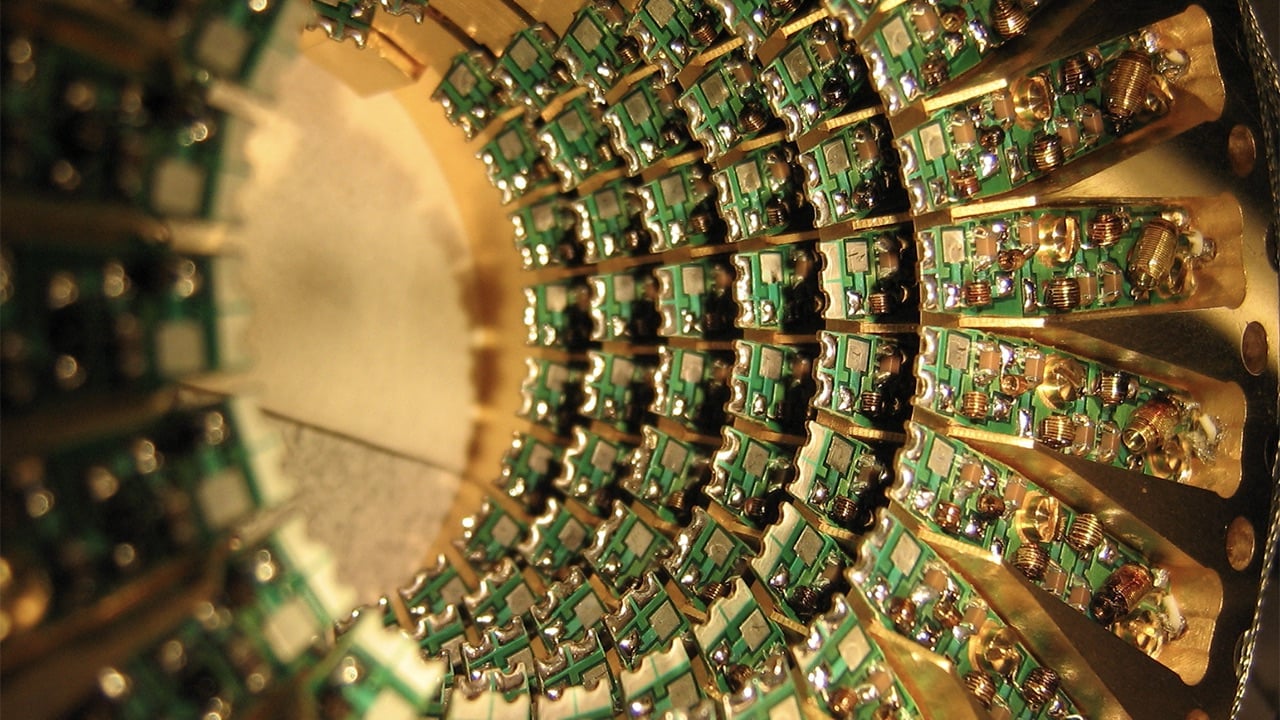
Photo by Steve Jurvetson, From flickr
Quantum Dots Offer Potential for a Secure Internet
- Written by Kiara Fabbri Former Tech News Writer
- Fact-Checked by Justyn Newman Former Lead Cybersecurity Editor
Researchers from Leibniz Universität Hannover (LUH), Physikalisch-Technische Bundesanstalt (PTB), and the University of Stuttgart, recently published a new method for secure communication in the quantum age. Their innovation utilizes semiconductor quantum dots and quantum key distribution (QKD) to enhance how sensitive information is shielded from cyber threats.
According to Phys.Org , traditional encryption relies on complex mathematical algorithms. However, with the rise of quantum computers, these methods are becoming increasingly vulnerable. This is because quantum computers can potentially crack these algorithms much faster than regular computers.
The German research team, led by Professor Fei Ding from Leibniz University, has addressed this challenge by utilizing semiconductor quantum dots (QDs), also known as ‘artificial atoms’, and quantum key distribution (QKD) .
According to Interesting Engineering , QKD offers a secure way to exchange encryption keys between parties. It relies on the principles of quantum mechanics to generate unbreakable keys, even by the most powerful quantum computers. This method uses single photons to carry these keys, and any attempt to intercept the transmission will introduce errors, immediately detectable by the parties involved.
However, implementing large-scale QKD networks has been hindered by limitations in current single-photon sources. This research team addressed this challenge by utilizing QDs as their photon source.
This innovative approach enabled them to achieve high secure key transmission rates over a distance of 49 miles (79 kilometers) between Hannover and Braunschweig. This achievement demonstrates the feasibility of using quantum dots for secure, long-distance communication.
Apple to Allow Rivals Access to Its Tap-and-Go Payment Services in the EU
- Written by Shipra Sanganeria Cybersecurity & Tech Writer
- Fact-Checked by Justyn Newman Former Lead Cybersecurity Editor
Apple settled a long-running European Union (EU) antitrust probe by agreeing to open its “tap to pay” service to rivals, the European Commission announced this week . This decision permits banks, payment services, and app developers to use Apple’s near-field communication, or NFC technology to create competing tap-and-go payment services on iPhones within the EU.
“Apple has committed to allow rivals to access the ‘tap and go’ technology of iPhones,” Margrethe Vestager, the European Commission’s executive vice president, in charge of competition policy, said in a statement.
The concession follows a major EU investigation launched in 2020 to assess whether Apple was exploiting its dominant position in the mobile wallet technology market to exclude competing payment service providers.
By May 2022, a preliminary investigation by the commission indicated that Apple’s actions had sidelined rivals to Apple Pay, limiting innovation and consumer choice in iPhone mobile wallets.
In response to these findings and to avoid potentially substantial fines, Apple proposed in January of this year to grant third-party mobile wallet and payment service providers access to the contactless payment function within its iOS operating system.
The European Commission then tested and gathered feedback on Apple’s proposal to ensure it addressed competition concerns. Apple adjusted its proposal based on this feedback, which has now been approved as legally binding by the Commission.
“Today’s decision makes Apple’ commitments binding,” continued Vestager. “From now on, competitors will be able to effectively compete with Apple Pay for mobile payments with the iPhone in shops. So consumers will have a wider range of safe and innovative mobile wallets to choose from.”
The settlement deal will be applicable throughout the European Economic Area (EEA) and will remain in force for ten years. It will not be applicable to Apple watches.
Reuters reports that Apple will offer developers in the EEA the ability to integrate NFC contactless payments and transactions into their iOS applications for uses in car keys, corporate badges, hotel keys, and concert tickets.
Lately, Apple has come under heightened scrutiny from the European regulatory authority over allegations of anti-competitive practices in the music streaming market and breaches of EU competition laws.
