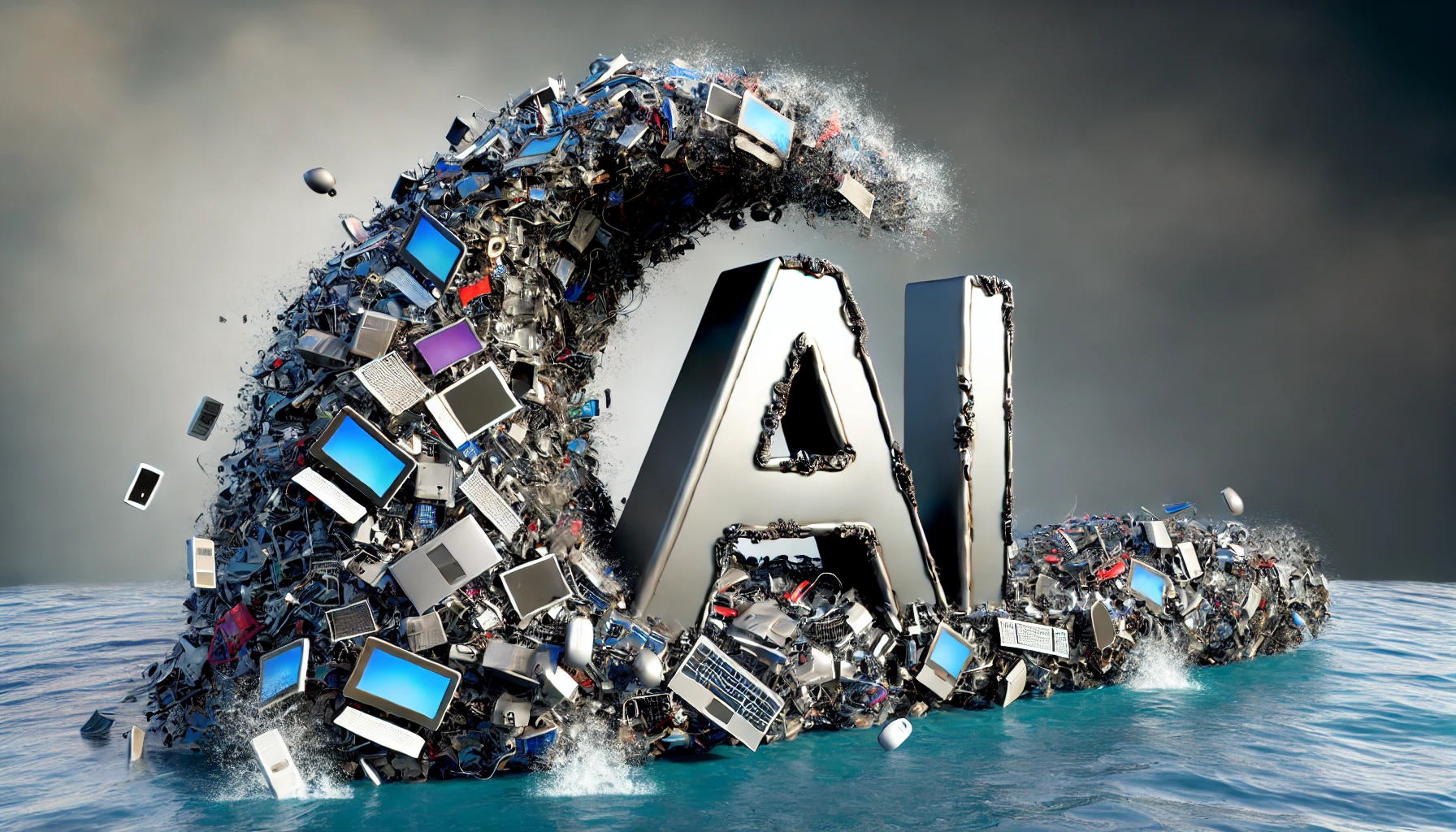
Image generated with DALL·E through ChatGPT
Opinion: The AI Boom Is Fueling E-Waste, Are We Ready For The Next Tech Trash Wave?
- Written by Andrea Miliani Former Tech News Expert
- Fact-Checked by Sarah Frazier Former Content Manager
Black Friday, Cyber Monday, and Christmas are right around the corner. As the holiday shopping season approaches, consumers are increasingly interested in electronics and generative AI capabilities can be an important factor for decision making. But what’s going to happen with our not-so-old devices?
Generative AI has spread contagiously across tech companies and the population worldwide, and manufacturers are responding to this trend by integrating AI into their products at an incredibly fast pace.
The AI hype is real and everywhere.
It’s hard to tell how big of an impact it is already having in our lives or predict what’s going to happen even next year, but experts have realized it will certainly have a substantial impact on e-waste.
A recent study published in Nature Computational Science predicted that e-waste related to generative AI technologies could reach 5 million metric tons by 2030. This is just a small fraction of what we are currently generating across the globe—over 60 million tons according to the United Nation’s Global E-waste Monitor 2024 —but significant enough to confirm that this issue is only getting worse.
The New, Shiny AI Technology
This year we have experienced the AI boom fueling the creation of new fascinating products and services we had never seen before.
From an AI-powered necklace that can listen and interact with users 24/7 , to a bartender robot that can serve cocktails and wine in New York, to super smart glasses that might soon replace our smartphones , to the latest models of traditional smartphones and computers now with faster, better, and more powerful AI technology.
Apple just released its new colorful iMacs with the M4 chip and Apple Intelligence—which is only compatible with the latest models. Those who have an iPhone 14 or older versions can forget about gaining access to the truly smart Siri.
Huawei recently launched a tri-fold AI-powered phone , Samsung its first AI-powered smart ring , Qualcomm a new powerful AI chip to make Android smartphones as powerful as PCs; and Nvidia, ADM, and now even OpenAI are developing new AI chips for new products that should replace our current devices soon.
Millions of tons of electronic waste
Millions of computers, smartphones, tablets, smart watches and rings that are not compatible with AI technologies will soon join walkmans, discmans, floppy discs, dvd players, and fax machines in the cemetery of outdated devices—or in third world countries like Malaysia, if we want to avoid euphemisms and address the reality and the consequences of e-waste for a minute.
The Malaysian government recently reported hundreds of shipping containers filled with e-waste in its ports, delivered illegally under different categories. About 106 out of 300 were inspected and local authorities revealed that the e-waste came from first-world countries like the United States.
“Unfortunately, many officials in some of these countries believe their e-waste is being processed in an environmentally friendly and ethical manner but don’t realize their waste is being sent to developing countries for processing,” said Nik Nazmi Nik Ahmad, Minister of Natural Resources and Environmental Sustainability.
UNITAR, in its global e-waste report, explains that tons of e-waste end up in uncontrolled landfills or in the environment affecting millions of humans—workers who deal with waste and nearby communities—and making a big and negative impact in nature. Electronic devices are made with hazardous materials—like cadmium, flame retardants, and mercury—and managing this waste properly costs billions of dollars across the globe.
Experts explain that it’s hard to predict exactly how sizeable the impact on e-waste related to AI will be, and that it will also depend on AI adoption in the following days, months, and years. Researchers suspect it’s going to be far-reaching: “Generative AI has been adopted at a faster pace than PCs or the internet,” revealed a recent study .
The potential solutions
Is there a way to slow down e-waste and reduce the snowball effect that is being accelerated by AI? The good news is that there are traditional and new solutions that combined could diminish the impact of the AI wave.
In its report, UNITAR acknowledges that good e-waste management has resulted in positive impact, like 28 billion worth of metals being reused as secondary raw material in 2022. Even if this process can be expensive—especially when done properly protecting workers from exposure to toxic substances and environments and avoiding emissions of greenhouse gasses—it’s still valuable and crucial that more companies, government and other organizations get involved. The current effort is good, but not enough to tackle the expected 62 tons of e-waste accumulating each year.
Another solution can be AI-powered. Anthropic recently released a new AI model , Claude 3.5 Sonnet, that can control PCs. While this feature is new—and in beta mode, only available for developers—it has the potential to be integrated with other applications and develop new technologies compatible with our current devices.
As good citizens, we have the responsibility to consider what will happen with our current devices when we no-longer want them, how we can support valuable initiatives, and take the time to meditate before buying that next gadget we want for the holidays. And, why not use AI to help us reduce AI-related waste?

Image by DC Studio, from Freepik
UNCG Integrates AI and VR Into Nursing Education
- Written by Kiara Fabbri Former Tech News Writer
- Fact-Checked by Sarah Frazier Former Content Manager
In a Rush? Here are the Quick Facts!
- VR simulations allow students to practice real-world clinical scenarios in a controlled setting.
- MetaQuest2 headsets with Oxford Medical Simulation software support the immersive VR program.
- Students can collaborate in small groups, sharing screens and making real-time decisions.
The School of Nursing (SON) at the University of North Carolina Greensboro (UNCG) announced that it is using AI to enhance nursing education, patient care, and practice by offering immersive learning experiences through virtual tools.
This approach integrates real-world clinical scenarios, allowing students to practice skills and make decisions independently in a controlled, virtual setting. The SON’s program includes virtual reality (VR) simulations that bring theoretical knowledge directly into practical application.
“We can talk about a health condition in class and then put on virtual-reality headsets to practice taking care of a patient,” explains Lindsay Draper, clinical associate professor at SON.
“Right then and there, they’re able to connect theory with clinical practice before they ever get to a clinical setting,” she added, as reported in the university press release.
Implemented in 2023, the VR program supports both undergraduate and nurse practitioner students, utilizing MetaQuest2 headsets with Oxford Medical Simulation software.
This platform offers access to more than 230 scenarios, including the option to create tailored cases. This flexibility allows students to learn critical skills, such as assessing patients, ordering labs, and developing patient interactions, in a realistic yet risk-free environment.
The press release states that the VR experience has proven beneficial for collaborative learning as well. Students can work in small groups, share screens, and discuss real-time decision-making, maximizing engagement and reducing downtime in simulation sessions.
The SON has extended AI use to course design, curriculum improvement, and assignment generation. Faculty leverage AI to develop curriculum rubrics and streamline assignments, while students use it in courses like Nursing Informatics and Technology to create study resources, and test questions.
Moving forward, UNCG’s SON aims to incorporate augmented reality and explore VR’s potential for interprofessional training and disaster preparedness.
The integration of AI also influences faculty productivity and informs health policy, with Dean Debra Barksdale leading initiatives in national organizations to shape ethical AI applications in nursing.
As AI continues to transform health education, SON faculty are sharing these advancements with broader communities and preparing the next generation of healthcare professionals.
Notably, studies show immersive VR training boosts nursing students’ performance, with one study finding that VR-trained students made significantly fewer errors compared to those using traditional clinical training.
Another study demonstrated that medical students who used VR alongside classical training made 40% fewer errors in simulated Arterial Blood Gas collection, underscoring VR’s potential to reduce clinical errors and improve medical education.
However, other studies highlight some limitations of VR in medical training. First, the transfer of skills from VR to clinical practice needs further evaluation. Second, VR procedures, especially those involving surgery, require careful and complex software design. Finally, the ability of VR to fully simulate real-life environments warrants ongoing review.
