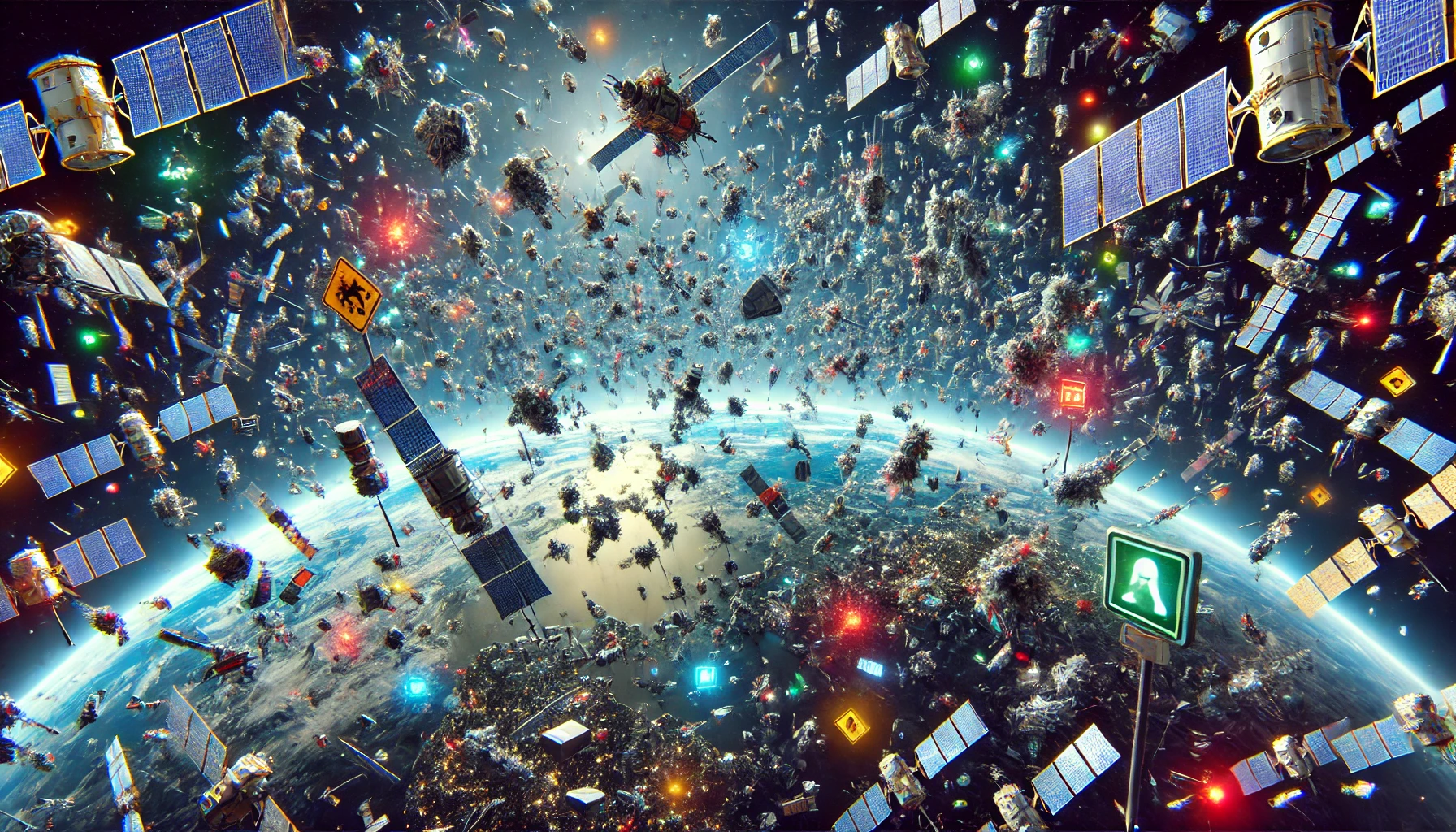
Image generated with DALL·E through ChatGPT
Opinion: Low Earth Orbit Is Getting Too Crowded And It’s A Problem For All Of Us
- Written by Andrea Miliani Former Tech News Expert
For years, I’ve heard about thousands of satellites orbiting the Earth, like those relentless clouds of mosquitoes that swarm travelers on tropical vacations or in parks during the summer. But the Earth isn’t on vacation—it’s dealing with this every single day. And the situation is more complicated than I thought.
Last week, the United Nations urged companies and governments to cooperate and work together to manage satellites. There are over 14,000 satellites— over 6,700 belong to Elon Musk’s Starlink—and more than 120 million pieces of space junk in orbit and that number is only expected to increase. Also last week, multiple European space companies—Airbus, Thales, and Leonardo—announced a new partnership to compete against Starlink with more satellites and similar services.
While the tech innovation is exciting and more and more necessary—satellites help us communicate globally, get oriented with our GPS, predict the weather, and entertain us with Internet connection in remote locations and TV shows—low Earth orbit (LEO) is getting too crowded.
And there’s a serious downside to this situation, there’s an increasing risk of collision and the consequences are seriously concerning.
The Current Situation
The impact satellites have in modern society is massive and governments and companies are relying on it more and more. Italy recently announced a partnership with Starlink to provide Internet services in remote locations, and Apple is planning on bringing satellite connection to Apple Watch next year to allow users to send messages without internet or cellular connection. There is news every week about new satellite launches, services, or research developments with this technology.
Satellites Can Crash
It’s hard to see satellites from the ground, especially from big cities with heavy light pollution, but they are there. I remember spotting dozens of satellites one night in the North of Chile, in Valle del Elqui—a world-class destination for stargazing—, but there’s no need to travel to clear skies destinations to understand this phenomenon, it’s actually better to see it online as you can gain a better perspective and understanding of the problem.
I recently discovered LeoLabs’ interactive map which displays objects in orbit in real-time and it’s a lot more terrifying than my fun outdoor experience. With up-to-date data, LeoLab—a company specializing in tracking objects in orbit—allows visitors to use the map to zoom in and out, filter, and sort objects for educational and research purposes.
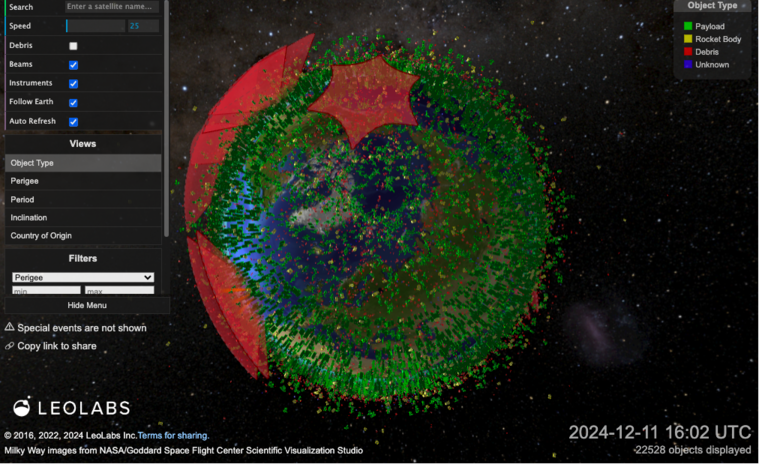
After seeing that map the big question can easily pop to our minds: How can they all stay in orbit without crashing? Thanks to inertia and gravity—and probably luck at this point. Satellites are strategically placed, at a precise speed, in order for them to stay in their orbital paths and are monitored and surveilled by multiple organizations, but these organizations are worried too.
The fear is justified. Experts have registered crashes and dangerous situations in the past years, and there have been many challenges along the way. Space debris—produced by human and natural activities—and “dead” satellites—many stop functioning in just a few years—are hard to predict and control.
Science journalist Marina Koren wrote a brilliant piece for The Atlantic published in June explaining that two important satellites—one from Russia and another one from the USA—almost crashed this year. She interviewed scientists and a few experts confessed to getting very scared. They agreed that the consequences of this happening could be “disastrous,” and the risk is imminent.
If more satellites collide, many things could happen. From losing our functional smartphones to not being able to pay by card to having hundreds of flights canceled—remember this year’s glitch in Microsoft Cloud that created chaos across airports worldwide? Well, something like that. In the worst case scenario, we could face the Kessler syndrome, a hypothetical phenomenon where satellites and debris crash continuously until Earth orbit becomes unusable for satellite technology.
Can’t We Just Fix It?
Well, it’s not that easy. Designing a system that all nations and enterprises can agree on and rely on is a huge challenge. Different countries have their own rules and laws about space, and information about satellite positions isn’t always shared openly.
According to recent data from WorldAtlas , the U.S. has a record of 247 military satellites in orbit, followed by China with 157, and Russia with 110. These devices have powerful technology like sensors and high-resolution cameras that help with communications, precise locations, and surveillance information. Do you see these three countries sharing real data on their military satellites? Me either!
Companies might also hesitate to give away details about their spacecraft, considering it sensitive business or security data. Agreeing on a global set of standards means bringing together all players at the same table—an almost utopian idea considering today’s complex political environment.
Signs Of Hope
But there is hope. Multiple organizations are working on solutions for the crowded LEO traffic and on ways to reduce space debris. LeoLab’s radar network is helping track satellites in real-time, and alert organizations, and they are working with the U.S. government to improve and develop their system.
The European Union created a Space Traffic Management program to reduce space debris with international agreements, research operations, sustainable rules, and safety measures to improve space traffic. The European Space Agency (ESA) committed to a ‘ Zero Debris approach ’ by 2030 making companies and governments take care of their trash.
“We are aiming for rules that compare to every national park on Earth – what you bring in you must take with you when you leave,” states ESA’s website.
Other companies like the Swiss startup ClearSpace and the Japanese Astroscale are developing “space clean-up” missions to remove debris and dead satellites. But these methods are expensive, require fuel, and more space travel. Cleaning service as a space business is still in a very early stage.
To achieve balance and a sustainable system for orbital traffic around our planet, a combination of strategies, international alliances, and perhaps a touch of luck is required. Current initiatives hold great potential, and although we are still far from achieving it, it seems that with persistence, effort, awareness, and determination, a solution is within reach.
Image by wirestock, from Freepik
SwagBot: The AI-Powered Robot Herding Cattle
- Written by Kiara Fabbri Former Tech News Writer
- Fact-Checked by Justyn Newman Former Lead Cybersecurity Editor
SwagBot, a bright red autonomous robot, is being hailed as the world’s first “smart cow” by researchers at the University of Sydney . Designed to make farming more efficient and environmentally friendly.
In a Rush? Here are the Quick Facts!
- It uses AI and sensors to assess pasture health and monitor livestock.
- SwagBot autonomously herds cattle to optimal grazing areas to prevent overgrazing.
- The robot helps farmers make real-time, detailed decisions about pasture management.
As the global population grows and food security becomes more urgent, adopting smarter farming methods is essential. Traditionally, research has focused on large-scale commercial agriculture, developing costly technologies and ever-bigger machinery, says The University of Sidney in the press release.
Professor Salah Sukkarieh , however, is tackling the issue from a different perspective. He is developing smaller, more affordable robots designed for smallholder farmers, helping them work more efficiently, sustainably, and productively.
Professor Sukkarieh and his team at ACR, within the Faculty of Engineering and Information Technologies, have created robots that could revolutionize farming practices.
In traditional farming, decisions are made based on entire paddocks. For example, if pests affect a few crops, farmers often spray the entire field to prevent further spread. Robotic technology, however, allows for pinpointing problem areas, enabling targeted treatment, says The University of Sidney.
This approach reduces costs, minimizes environmental impact, and boosts crop yields.
Among the innovations is SwagBot, the world’s first robot designed for grazing livestock, and RIPPA, a durable robot capable of navigating fields and orchards, monitoring and enhancing vegetable and fruit production for improved yields.
Originally launched in 2016 as a basic herding robot, SwagBot has since undergone significant upgrades, now incorporating advanced sensors, AI, and machine learning systems, as reported by Reuters .
Additionally, the battery-powered robot can assess the health, type, and density of pasture while monitoring livestock health. Using this data, SwagBot autonomously herds cattle to the most suitable pastures, moving them before overgrazing occurs and soil quality declines, notes Reuters.
Professor Sukkarieh explains to Reuters, “Once the cattle are used to the robot, they will follow the robot around.” This technology eliminates the need for traditional fencing, allowing animals to be moved seamlessly to areas with optimal nutritional value.
Retuers notes that Australia, one of the world’s largest beef exporters, faces unique challenges with its vast, often dry landscapes. With around 30 million cattle and limited control over grazing patterns, farmers are at risk of overgrazing, which degrades soil health.
SwagBot addresses this issue by providing real-time, detailed pasture assessments, offering a more efficient and sustainable approach to managing large herds. Erin O’Neill, a part-time farmer who witnessed a recent SwagBot demonstration near Sydney, emphasizes its benefits.
“That allows us to know what bits of pasture are most nutritious, particularly if you’ve got cattle like we do that are pregnant and therefore need a higher quality pasture to aid them through that pregnancy.” she says to Reuters.
While still in development, SwagBot represents a growing trend in agricultural robotics, which aims to improve efficiency and reduce reliance on human labor, particularly in remote areas like Australia.
