
Photo by Miguelangel Perez on Unsplash
OpenAI Rolls Out Voice Feature For ChatGPT Plus
- Written by Andrea Miliani Former Tech News Expert
- Fact-Checked by
“We’re starting to roll out advanced Voice Mode to a small group of ChatGPT Plus users,” wrote OpenAI on X, “Advanced Voice Mode offers more natural, real-time conversations, allows you to interrupt anytime, and senses and responds to your emotions.”
We’re starting to roll out advanced Voice Mode to a small group of ChatGPT Plus users. Advanced Voice Mode offers more natural, real-time conversations, allows you to interrupt anytime, and senses and responds to your emotions. pic.twitter.com/64O94EhhXK — OpenAI (@OpenAI) July 30, 2024
The company added that users who get to test the alpha version will get an email with instructions to learn how to use Voice Mode.
According to Forbes , OpenAI delayed its rollout—initially expected to be deployed in June—due to safety concerns and adjustments as the company claimed to need more time to reach “launch standard.” OpenAI set back after the actress Scarlett Johansson requested more information about the AI assistant’s voice called “Sky” as it was “eerily similar” to hers.
The voice Sky—used during the demonstration at the live event—is not available in the new release, and OpenAI hasn’t disclosed more information about the source of the voice.
According to MIT Technology Review , the new voice model powered by GPT-4o will be capable of more natural conversations compared to Siri and Alexa, and capable of recognizing emotions, responding to interruptions, and combining and integrating text and visual capabilities.
OpenAI expects to get more feedback during this period before releasing the voice-enabled chatbot to a wider audience later this year, in the fall. The company said it has tested the model with over 100 external testing team members in 45 languages across 29 countries.
One of the safety measures considered before launching the voice feature was audio deepfakes. The new voice model will not be allowed to create voice deepfakes; it will only use four voices chosen in collaboration with actors.
OpenAI expects to release more features soon—like video and screen sharing—for its AI assistant model. Just a few days ago, the tech company released a new AI-powered search engine called SearchGPT expected to compete against Google.
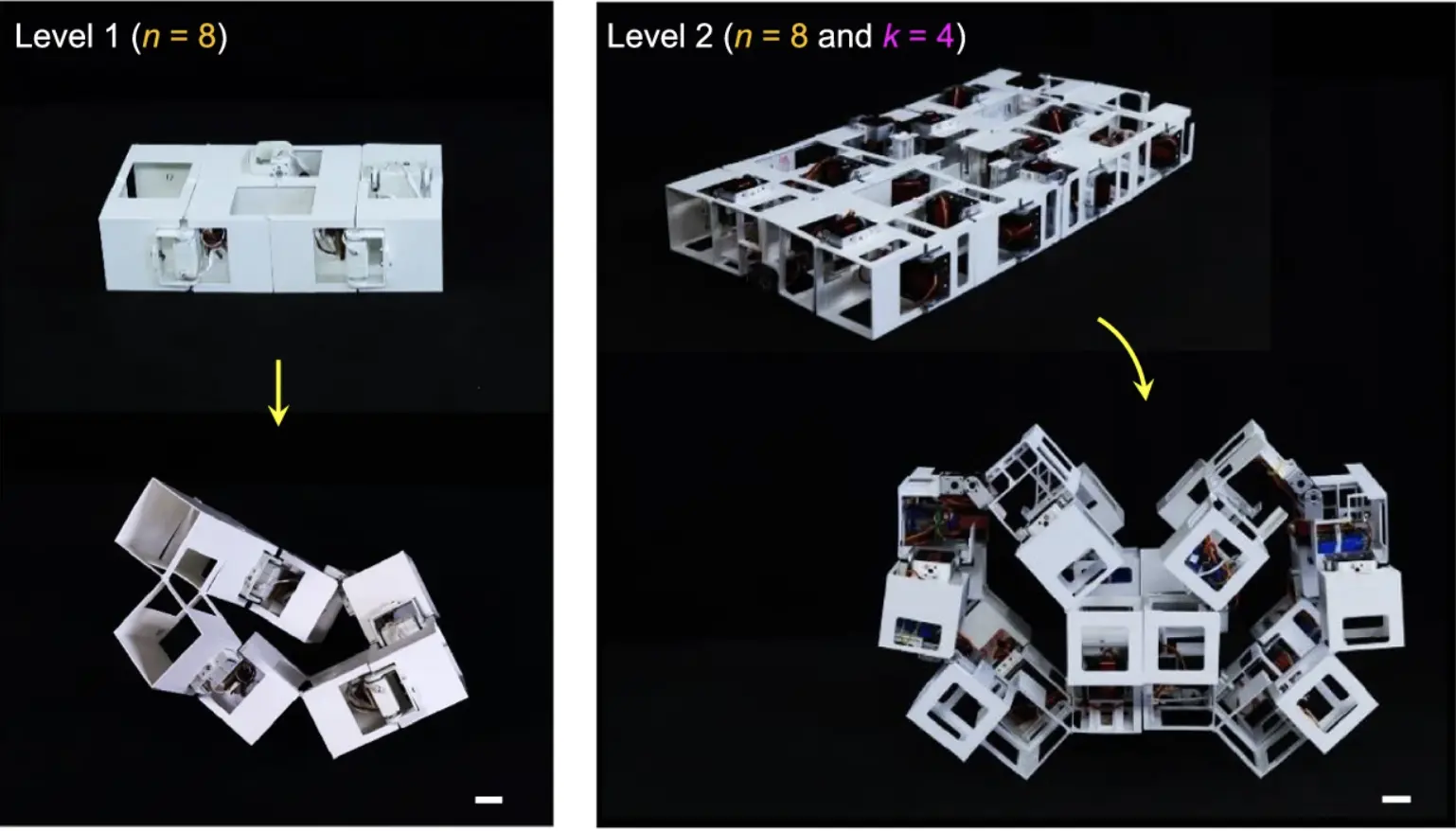
Image extraction from: Adaptive hierarchical origami-based metastructures, DOI: 10.1038/s41467-024-50497-5
NC State University Develop Shape-Shifting Robot Inspired by Origami
- Written by Kiara Fabbri Former Tech News Writer
- Fact-Checked by
A team of researchers at North Carolina State University has created a plastic cube structure capable of transforming into over 1,000 configurations using just three motors. This breakthrough could lead to the development of versatile robots for various applications, particularly in architecture and space exploration.
In their research paper , the team explains how they used a 3D printer to assemble 36 hollow plastic cubes connected by rotating hinges. Some hinges were fixed with metal pins, while others were motorized. This configuration allowed the structure to morph into a variety of shapes , including tunnels, bridges, and multi-story structures.
By changing shape, the transformer bots can move in all directions and carry loads up to three times their own weight, all without the need for feet.
The shape-shifting bots can adapt to different tasks and environments, making them potentially useful for multifunctional applications in fields like space exploration . The bots’ ability to carry loads and change shape as needed could revolutionize the design of artificial systems.
“We think these can be used as deployable, configurable space robots and habitats,” said Antonio Di Lallo, a co-first author of the paper. “It’s modular, so you can send it to space flat and assemble it as a shelter or as a habitat and then disassemble it.”
While the technology holds great promise, there are some limitations. The load-bearing capacity of the structures, especially at larger scales, needs improvement. Current prototypes are limited in their ability to handle significant weight due to the materials used for hinges, which sacrifice strength for flexibility. Additionally, the researchers noted challenges in fully leveraging the shape-morphing capabilities for diverse robotic locomotion in unstructured environments.
The research opens new avenues for future exploration. “We want to make a more robust structure that can bear larger loads,” stated Yanbin Li, a co-corresponding author of the paper. “If we want a car shape, for example, how do we design the first structure that can transform into a car shape? We also want to test our structures with real-world applications like space robots.”
The study, published in Nature Communications, was supported by grants from the National Science Foundation. This innovative approach to robotic design could lead to new advancements in artificial systems, making them more adaptable and functional for various applications.
