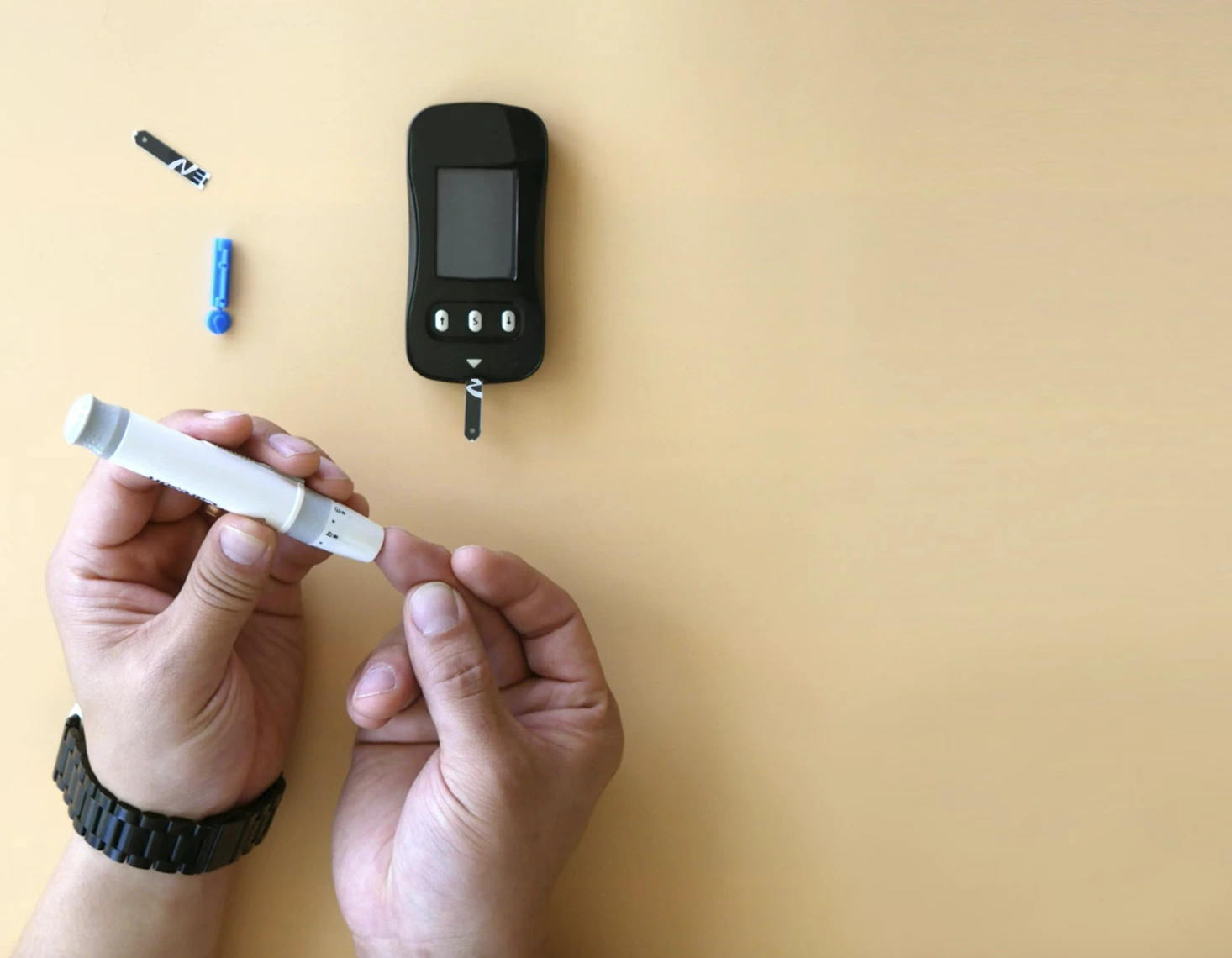
Image by isens usa, from Unsplash
NHS Trials AI Technology To Spot Diabetes Risk A Decade In Advance
- Written by Kiara Fabbri Former Tech News Writer
- Fact-Checked by Justyn Newman Former Lead Cybersecurity Editor
Two NHS hospital trusts in London are pioneering the use of artificial intelligence (AI) to identify type 2 diabetes risk up to a decade before symptoms emerge, as first reported by the BBC .
In a Rush? Here are the Quick Facts!
- AI system Aire-DM detects type 2 diabetes risk via ECGs up to 10 years early.
- The system predicts diabetes risk with 70% accuracy, improving with additional data.
- Clinical trials involving 1,000 patients will begin in 2025 to evaluate effectiveness.
Imperial College and Chelsea and Westminster NHS foundation trusts have begun training Aire-DM, an AI system designed to analyze electrocardiograms (ECGs) for subtle, early warning signs of the condition.
The technology focuses on detecting changes in ECG heart traces that are too nuanced for doctors to spot unaided. “It’s not as simple as saying it’s this or that bit of the ECG,” explained to the BBC Dr. Fu Siong Ng, lead researcher. “It’s looking at a combination of subtle things.”
The BBC reported that preliminary results suggest Aire-DM can predict diabetes risk with approximately 70% accuracy. When combined with other patient data, such as age, sex, blood pressure, and weight, the system’s accuracy improves. Clinical trials, scheduled for 2025, aim to evaluate its effectiveness further.
An ECG records the heart’s electrical activity, revealing issues like rate and rhythm. Aire-DM leverages this data to provide insights that could revolutionize early diabetes detection.
According to the BBC, up to 1,000 patients across the two trusts will participate in the trials, which researchers hope will pave the way for wider NHS adoption. However, experts caution that implementation across the health service may take at least five years.
The British Heart Foundation, which is funding the project, underscores its potential to save lives.
“This exciting research uses powerful artificial intelligence to analyse ECGs, revealing how AI can spot things that cannot usually be observed in routinely collected health data,” said to the BBC Professor Bryan Williams, the foundation’s Chief Scientific and Medical Officer.
“This kind of insight could be a gamechanger in predicting future risk of developing type 2 diabetes, years before the condition begins,” he added.
Dr. Faye Riley of Diabetes UK highlighted the importance of early intervention. “AI-powered screening methods offer a promising new way to spot those likely to develop type 2 diabetes years in advance, allowing them to access the right support and prevent serious complications, such as heart failure and sight loss,” she said to the BBC.
This initiative reflects a growing trend of integrating AI into healthcare. Beyond diabetes prediction, the NHS has already adopted AI for detecting fractures and diagnosing lung cancer .
Additionally earlier this month, the NHS announced to be leveraging AI and High Intensity Use (HIU) services to identify frequent A&E users and provide tailored care. This initiative addresses underlying issues like poverty and social isolation, reducing A&E visits by over half in some areas.
AI predicts at-risk patients, offering preventative support and easing NHS pressures. Overall the NHS argues that AI is transforming healthcare by automating repetitive tasks, enabling faster, more accurate diagnoses, reducing errors, and lowering costs.
AI empowers patients with direct access to health information, promoting democratization of care. However, challenges persist, including data privacy, lack of standards, and ethical concerns like accountability and transparency.
However the NHS also notes that AI systems depend on training data, which may not always reflect clinical realities, necessitating realistic expectations. Healthcare practitioners must adapt , learning when and how to use AI, interpret results, and communicate effectively.
This shift requires updated training to maximize AI’s benefits while navigating its complexities and ensuring equitable, trustworthy healthcare delivery.

Image by DC Studio, from Freepik
North Korean Hackers Linked to $305 Million DMM Bitcoin Heist, Authorities Confirm
- Written by Kiara Fabbri Former Tech News Writer
- Fact-Checked by Justyn Newman Former Lead Cybersecurity Editor
The FBI, Japan’s National Police Agency, and the Department of Defense Cyber Crime Center have identified North Korean-linked hackers as the orchestrators of a $305 million cyberattack on Japanese cryptocurrency exchange DMM Bitcoin in May 2024.
In a Rush? Here are the Quick Facts!
- Attack attributed to TraderTraitor, active since 2020, targeting Web3 companies.
- Hack stemmed from a LinkedIn-based social engineering attack on Ginco employees.
- Stolen crypto laundered through CoinJoin Mixer and Cambodian HuiOne Guarantee.
A joint statement issued on December 23 attributes the breach to the TraderTraitor threat group, also known as Jade Sleet, UNC4899, and Slow Pisces.
Hacker News explains that TraderTraitor, active since at least 2020, is known for targeting Web3 companies through malware-laced cryptocurrency apps.The group often employs job-themed social engineering campaigns or pretends to collaborate on GitHub projects to deploy malicious npm packages and facilitate theft.
The authorities revealed that the DMM Bitcoin breach originated from a social engineering attack on Ginco, a Japanese crypto wallet software company. In March, a North Korean operative posing as a LinkedIn recruiter shared a malicious Python script disguised as a pre-employment test with a Ginco employee.
When the employee copied the script to their personal GitHub account, it exposed sensitive session cookie data, enabling the hacker to impersonate the employee and infiltrate Ginco’s communication system.
By May, the threat actor used their access to manipulate a legitimate transaction request from a DMM Bitcoin employee, ultimately stealing 4,502.9 BTC, valued at $305 million.
Blockchain intelligence firm Chainalysis corroborated the findings, explaining how the attackers exploited infrastructure vulnerabilities to siphon funds.
They laundered the stolen cryptocurrency through intermediary addresses, a Bitcoin CoinJoin Mixing Service, and bridging services before transferring it to HuiOne Guarantee, an online marketplace linked to Cambodia’s HuiOne Group, a known facilitator of cybercrimes.
Finance Feeds reports that DMM Bitcoin has announced plans to cease operations, reaching an agreement with SBI VC Trade, the cryptocurrency division of Japanese financial giant SBI Group, to transfer its assets and customer accounts by March 2025.
Finance Feeds further notes that DMM Bitcoin clarified that while custodial assets are being transferred to SBI, leveraged trading positions will not be included. Customers must settle all open positions before the handover. The exchange confirmed it will shut down once the transfer is complete.
This disclosure underscores ongoing cybersecurity risks in the Web3 sector, with TraderTraitor remaining a persistent threat targeting the global cryptocurrency landscape.
