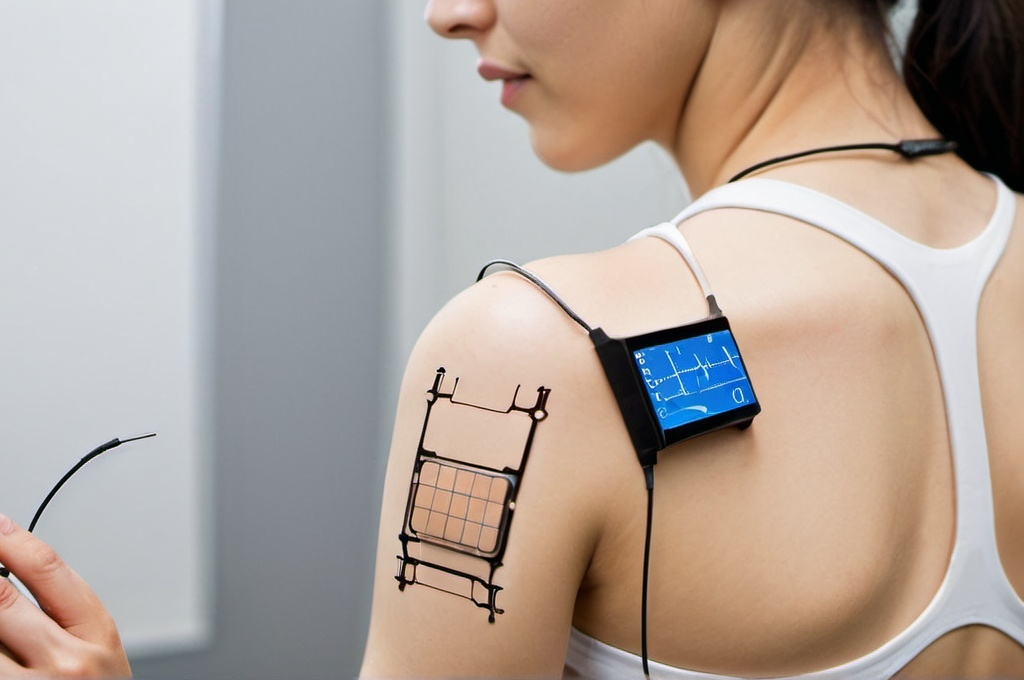
AI image created with Openart.ai
New Wearable Sensor Enables Non-Invasive Health Tracking to Detect Disease Early
- Written by Kiara Fabbri Former Tech News Writer
- Fact-Checked by
Researchers from Singapore have just announced a new wearable sensor that continuously monitors key skin biomarkers like cholesterol and lactate without invasive procedures. This technology aims to enhance early disease detection by providing a more convenient alternative to traditional methods.
The sensor, created by a team led by Assistant Professor Liu Yuxin from the National University of Singapore (NUS) and Dr. Yang Le from the Agency for Science, Technology, and Research (A*STAR), is designed to monitor health indicators directly on the skin. Unlike current methods that require blood, urine, or sweat samples, this device uses a hydrogel-based, stretchable material to detect biomarkers.
The sensor’s technology allows it to monitor health markers in real-time, which could be particularly useful in managing chronic diseases, conducting large-scale health screenings, and monitoring athletes’ performance.
The device operates by allowing biomarkers to dissolve into its hydrogel layer, where they undergo electrochemical reactions. This data is then transmitted wirelessly to an external device for analysis.
The researchers state that the sensor’s ability to monitor biomarkers on dry skin without the need for sweat sets it apart from other wearable technologies.
The development of this sensor addresses some of the challenges associated with traditional health monitoring methods. Blood tests are invasive and can be inconvenient, while other methods, like urine analysis, often lack real-time monitoring capabilities.
“Rather than subject pregnant women to multiple blood draws, our sensor could be used to track real-time sugar levels conveniently in patients’ homes, with a similar level of accuracy as traditional tests. This also can be applied to diabetes in general, replacing the need for regular finger-prick tests,” explained Asst Prof Liu in the YouTube presentation.
The researchers also envision using the sensor in conjunction with AI modeling to assess a patient’s resilience prior to major surgeries, such as open heart procedures.
Further research is underway to enhance the sensor’s performance and broaden its applications. The research team is also collaborating with hospitals to validate the technology clinically.

Image by MahmudAl, from Pixabay
AI Shows Potential In Early Autism Detection
- Written by Kiara Fabbri Former Tech News Writer
- Fact-Checked by Justyn Newman Former Lead Cybersecurity Editor
A research paper published yesterday presented some promising results of a machine learning model designed to identify children at risk of autism spectrum disorder (ASD) at an early age. The model, named AutMedAI, achieved an accuracy rate of 80%, offering hope for early detection.
Developed by researchers at Karolinska Institutet, AutMedAI analyzed data from approximately 30,000 individuals to identify patterns linked to autism. The data was based on 28 parameters that can be easily obtained before a child turns two, such as the age of the first smile, the first short sentence, and the presence of eating difficulties.
In a statement , the study author Shyam Rajagopalan emphasized the significance of these findings: “The results of the study are significant because they show that it is possible to identify individuals who are likely to have autism from relatively limited and readily available information.”
The researchers highlight the potential of this study to screen children at an early age, which could lead to the implementation of timely interventions, helping children with autism develop optimally.
However, the researchers caution that while the findings are promising, the model is not a substitute for comprehensive clinical evaluation. Further research and validation are needed to fully assess the model’s potential for clinical use.
It’s important to note that AI tools can sometimes lead to misdiagnosis with potentially harmful consequences . A recent study found that AI struggled to accurately diagnose pediatric cases, with incorrect diagnoses in 83% of the cases it analyzed.
“Generative AI technologies have the potential to improve health care, but only if those who develop, regulate and use these technologies identify and fully account for the associated risks,” said Jeremy Farrar, the WHO’s chief scientist, as reported by Nature .
