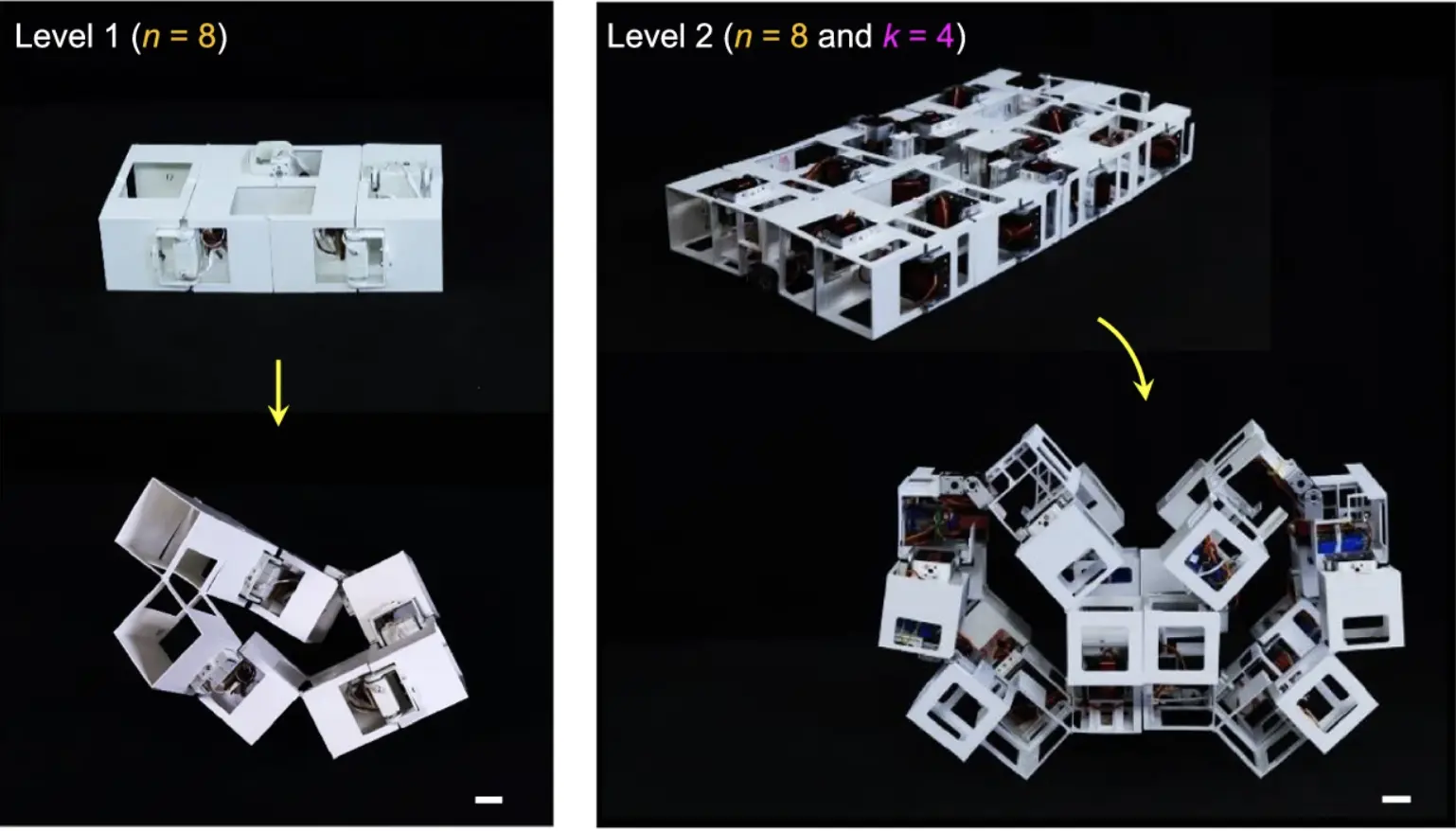
Image extraction from: Adaptive hierarchical origami-based metastructures, DOI: 10.1038/s41467-024-50497-5
NC State University Develop Shape-Shifting Robot Inspired by Origami
- Written by Kiara Fabbri Former Tech News Writer
- Fact-Checked by
A team of researchers at North Carolina State University has created a plastic cube structure capable of transforming into over 1,000 configurations using just three motors. This breakthrough could lead to the development of versatile robots for various applications, particularly in architecture and space exploration.
In their research paper , the team explains how they used a 3D printer to assemble 36 hollow plastic cubes connected by rotating hinges. Some hinges were fixed with metal pins, while others were motorized. This configuration allowed the structure to morph into a variety of shapes , including tunnels, bridges, and multi-story structures.
By changing shape, the transformer bots can move in all directions and carry loads up to three times their own weight, all without the need for feet.
The shape-shifting bots can adapt to different tasks and environments, making them potentially useful for multifunctional applications in fields like space exploration . The bots’ ability to carry loads and change shape as needed could revolutionize the design of artificial systems.
“We think these can be used as deployable, configurable space robots and habitats,” said Antonio Di Lallo, a co-first author of the paper. “It’s modular, so you can send it to space flat and assemble it as a shelter or as a habitat and then disassemble it.”
While the technology holds great promise, there are some limitations. The load-bearing capacity of the structures, especially at larger scales, needs improvement. Current prototypes are limited in their ability to handle significant weight due to the materials used for hinges, which sacrifice strength for flexibility. Additionally, the researchers noted challenges in fully leveraging the shape-morphing capabilities for diverse robotic locomotion in unstructured environments.
The research opens new avenues for future exploration. “We want to make a more robust structure that can bear larger loads,” stated Yanbin Li, a co-corresponding author of the paper. “If we want a car shape, for example, how do we design the first structure that can transform into a car shape? We also want to test our structures with real-world applications like space robots.”
The study, published in Nature Communications, was supported by grants from the National Science Foundation. This innovative approach to robotic design could lead to new advancements in artificial systems, making them more adaptable and functional for various applications.

Photo by Brett Jordan on Unsplash
Meta Launches AI Studio Tool In The U.S.
- Written by Andrea Miliani Former Tech News Expert
- Fact-Checked by
Meta launched a new AI-powered tool called AI Studio in the United States on Monday. According to the official announcement , AI Studio, built with Llama 3.1, will allow users to create AI characters and AI versions of themselves to interact with other users.
“We’re starting to roll out AI Studio in the US as a place for people to create, share, and discover AIs,” states Meta in the press release. “With AI Studio, we’re taking the first steps in creating a world where anyone can harness the creative capabilities of AI – and this is just the beginning.”
To create AI characters, users can go to AI Studio’s website and choose to create an AI character or do it on Instagram. AI Studio’s platform provides users with multiple prompt templates and ideas that they can use to create and later share with friends and followers through the web, Instagram, Whatsapp, and Messenger.
Users can assign their AI characters a name, personality, tagline, avatar, and tone. In the press release, Meta shows a few examples of the characters users have created, like an AI called Eat Like You Live There! created by chef Marc Murphy that provides tips for local dining to travelers, or What Lens Bro, an AI created by photographer Angel Barclay to help users choose the best lens for their photography project.
Meta highlights that content creators can benefit from AI Studio by building AI versions of themselves to interact with fans and answer common questions via DM.
The new tool is powered by Llama 3 , the advanced AI model the company launched in April to catch up in the AI race. Meta also recently launched AI tools for WhatsApp business .
Meta has not disclosed when Studio AI will be available in other countries. The tech giant has been facing legal difficulties with regions concerned about data use and privacy policies like the European Union and, more recently, Brazil—forcing Meta to withdraw AI services.
