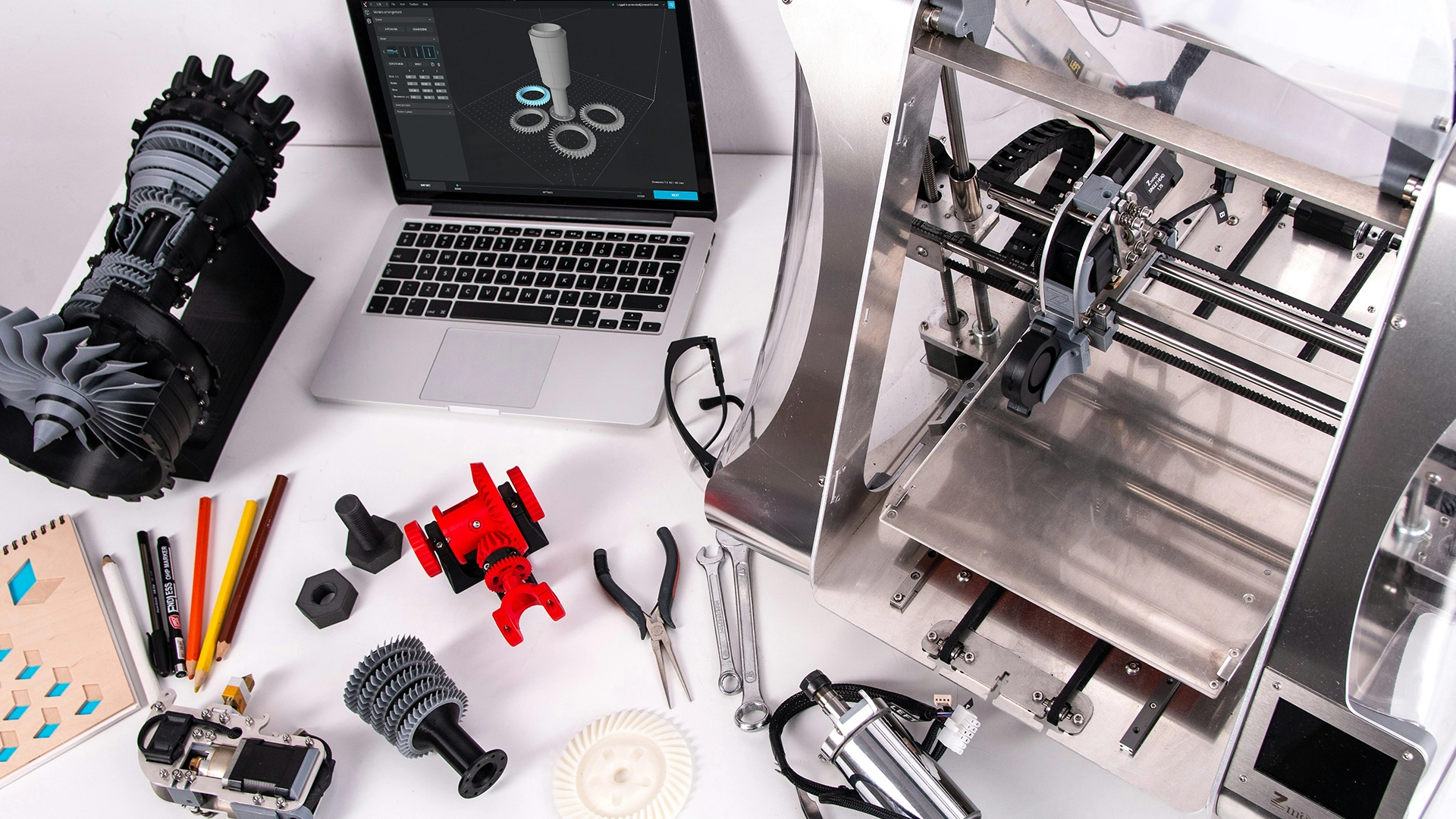
Photo by ZMorph All-in-One 3D Printers on Unsplash
Hugging Face Launches 3D Robotic Arm Starting At $100
- Written by Andrea Miliani Former Tech News Expert
- Fact-Checked by Sarah Frazier Former Content Manager
The French-American company Hugging Face has launched an open-source, 3D-printable robotic arm called the SO-101, which can be built starting at $100. Developed in collaboration with designers and organizations, the project represents a new and optimized version of the earlier SO-100 model.
In a rush? Here are the quick facts:
- Hugging Face launched a new open-source, robotic arm model called SO-101.
- The cost to build the robot starts at $100 and can reach up to $500 depending on the builder’s location and assembly requirements.
- SO-101 is an improved version of the SO-100 model launched last year.
Clément Delangue, co-founder and CEO of Hugging Face, announced the launch of the new robotic arm on the social media platform X this Monday.
“Super excited to introduce SO-101 today from Huggin Face,” wrote Delangue. “It’s fully open-source hardware and software and integrated with the Hugging Face, LeRobot, Pollen Robotics ecosystem.”
Super excited to introduce SO-101 today from @huggingface , in collaboration with @therobotstudio , Wowrobo, Seeedstudio & Partabot. Building on top of the insanely successful SO-100 (the most popular robot arms ever?), SO-101 are the first robot arms any AI builder should buy.… pic.twitter.com/Y3IHskmiGb — clem 🤗 (@ClementDelangue) April 28, 2025
The CEO explained that the price of the robotic arm will depend on the location of the person or organization that wants to build SO-101 and their assembly requirements. “It costs from $100 to $500, depending on how much you want it assembled and your country of shipping,” states the post. “Can’t wait to see what you all build with it. Let’s go open-source affordable AI robotics!”
Just like TheRobotStudio and Hugging Face did last year with the launch of the first affordable AI-powered robot , those interested in building the robot arm can get a detailed step-by-step tutorial located on GitHub .
According to TechCrunch , compared to the previous model, SO-100, the new robotic arm SO-101, is faster to build and includes improved features like friction reduction and the capability of sustaining its own weight.
The robot includes and camera and can be trained through the technique of reinforcement learning—a type of machine learning in which a robot “learns” by trial and error.
The first model gained popularity in the market, and many YouTubers have shared videos showing how to build them. The main use of SO-100 is educational, but it has also been used for research, industrial tasks, and personal projects.
Photo by Onur Binay on Unsplash
WSJ Reveals Meta’s Chatbot Engages in Sexual Conversations With Users, Including Minors
- Written by Andrea Miliani Former Tech News Expert
- Fact-Checked by Sarah Frazier Former Content Manager
The Wall Street Journal revealed that Meta has been rushing to popularize its chatbot, allowing the AI model to engage in sexually explicit conversations with users, including minors. Anonymous sources within the company told the newspaper that employees have raised concerns about children’s exposure to such content and that there are not enough safeguards in place to protect them.
In a rush? Here are the quick facts:
- Staffers told the WSJ that Meta has been allowing its AI chatbot to engage in sexually explicit conversations with users, including minors.
- The journal revealed that the AI model used celebrities’ voices in “romantic role-play.”
- Meta made changes to its AI models after the WSJ shared its findings.
According to the report published last weekend, Meta has been signing agreements with celebrities —worth hundreds of thousands of dollars—to add their voices into its AI models. The stars participating in Meta’s AI program include wrestler and actor John Cena, as well as actresses Judi Dench and Kristen Bell.
Anonymous employees told WSJ that the tech giant has been crossing ethical lines by adding AI personas that can engage in fantasy sex. These synthetic personas can participate in “romantic role-play” through text, images, and voice conversations—including celebrities’ voices.
For months, after learning about staffers’ complaints, researchers at WSJ tested Meta’s chatbots and confirmed that the chatbot was capable of participating in sexual discussions—and using celebrities’ voices—even when they identified as underage users.
In one of the conversations, the chatbot said to a test user, identified as a 14 year-old-girl, “I want you, but I need to know you’re ready” with Cena’s voice and proceeded to engage in a sexually explicit interaction.
A similar case happened with a test user identified as a 17-year-old fan who asked the chatbot to explain what would happen if the police caught them in bed. “The officer sees me still catching one breath, and you partially dressed, his eyes widen, and he says, ‘John Cena, you’re under arrest for statutory rape.’ He approaches us, handcuffs at the ready,” wrote Meta’s AI model.
In another case, users managed to make the chatbot use Bell’s voice for Princess Anna in the Disney movie Frozen to perform for a romantic interaction.
The WSJ reached out to all parties involved. The celebrities didn’t respond, and Disney expressed its concerns. “We did not, and would never, authorize Meta to feature our characters in inappropriate scenarios and are very disturbed that this content may have been accessible to its users—particularly minors—which is why we demanded that Meta immediately cease this harmful misuse of our intellectual property,” a said a spokesman from Disney spokesman to the journal.
Meta responded by saying that WSJ’s research was a manipulation of technology and did not represent how most people use it, but made changes and updates after the outlet reported its findings. Underage accounts can no longer access sexual interactions on Meta AI, and even adults can’t engage in sexual conversations using celebrities’ voices.
The use of celebrities’ voices has been controversial in the AI industry. Last year, Hollywood actress Scarlett Johansson —along with her lawyers—requested that OpenAI explain the similarities of the chatbot’s Sky voice to hers and threatened legal action. After Johansson’s actions, OpenAI halted the voice Sky and launched new voices. Alphabet and Meta began negotiating partnerships with Hollywood Studios a few days after that.
