
Photo by Adam Khan on Unsplash
Google And Air France Announce New Partnership To Deploy AI Technology
- Written by Andrea Miliani Former Tech News Expert
Google Cloud—Google’s suite of cloud computing services—announced today a new partnership with the airline Air France-KLM to deploy generative AI technology to optimize and power the travel company’s services.
In a Rush? Here are the Quick Facts!
- Google Cloud announced a new partnership with the airline Air France-KLM to deploy generative AI technology
- Air France-KLM expects to optimize data processing, improve its services and aircraft operations, and provide better experiences for customers
- Google will provide training in data science, engineering, security, and AI.
According to the press release , with a generative AI-powered system provided by Google Cloud, the Franco-Dutch airline group will be able to optimize travel experiences for its customers and for its own operations.
“Our collaboration with Google Cloud is a significant step forward in our data strategy,” said Pierre-Olivier Bandet, Air France-KLM Group EVP and group CIO. “By leveraging Google Cloud’s advanced data technology with a real partnership approach, we intend to accelerate our innovation capacities with security in mind, and with generative AI, build the future of travel.”
Air France-KLM operates 551 aircraft and over 93 million passengers used their services in 2023. The company is now moving from its legacy data centers to a multi-cloud approach and making the most of Google Cloud’s services like BigQuery to process data safely.
The airline expects to gain a better understanding of its customers’ behavior, travel patterns, and preferences to enhance operations during flights, at the airport, and through its services to develop analyses, create more accurate predictions, and reduce maintenance time and environmental impact for its aircraft.
Google Cloud will also provide training and support sessions for Air France-KLM’s teams. Through events, online learning experiences, and on-site experiences, the companies expect to help workers gain knowledge and new capabilities in AI, engineering, data science, and safety to manage the new technologies.
“Airlines generate massive amounts of data, much of which can be incredibly valuable in helping drive operational insights, build better customer experiences, and – with the power of gen AI – create entirely new services and offerings,” said Matt Renner, President, Global Revenue at Google Cloud. “We’re proud to support Air France-KLM in its innovation journey and to help the group define the future of the airline industry.”
Other European airlines have also been working with tech companies this year to improve services and provide customers with better experiences. A few weeks ago, Starlink partnered with Air France to provide free wifi in all aircraft starting next year.
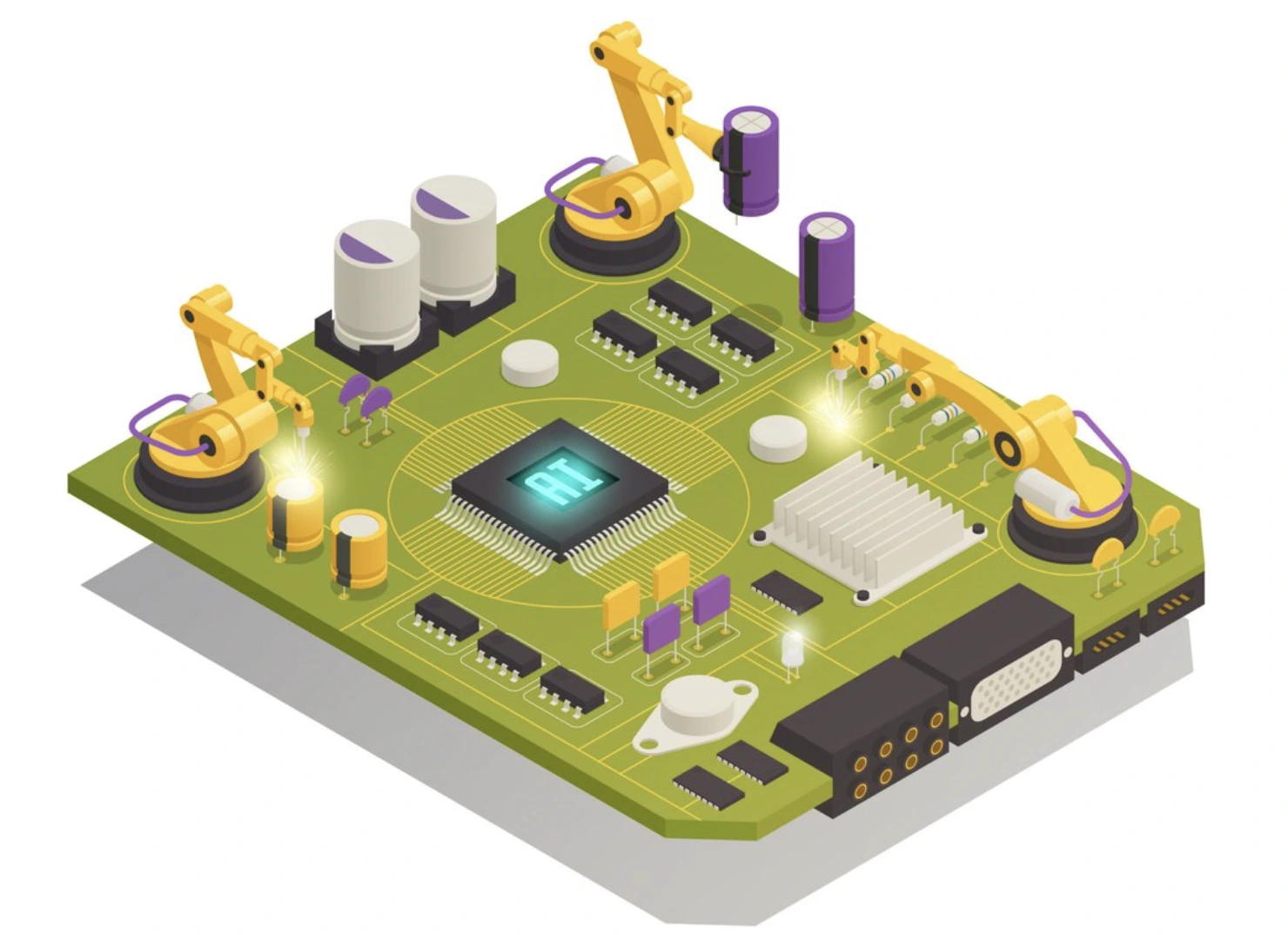
Image by macrovector, from Freepik
New Photonic Processor Promises Faster, More Energy-Efficient AI Computations
- Written by Kiara Fabbri Former Tech News Writer
- Fact-Checked by Justyn Newman Former Lead Cybersecurity Editor
Researchers from MIT have developed a new photonic chip that could significantly improve the speed and energy efficiency of artificial intelligence AI computations, as reported on Monday in a press release by MIT .
In a Rush? Here are the Quick Facts!
- MIT developed a photonic chip for faster, more energy-efficient AI computations.
- It completes computations in under half a nanosecond with 92% accuracy.
- The technology could improve AI applications like navigation, telecommunications, and scientific research.
This chip uses light to perform the essential operations of deep neural networks, a type of machine learning model, offering a faster alternative to traditional electronic processors. Deep neural networks are used in a wide range of AI applications, from image recognition to natural language processing, said MIT.
These models require significant computational power, and as they grow more complex, they can exceed the capabilities of conventional electronic hardware.
The new photonic processor, however, addresses this challenge by leveraging light to perform computations instead of electricity, which allows it to run more efficiently, according to MIT.
The photonic chip performs key tasks like matrix multiplication, a crucial operation in deep learning, using light. This process, which would typically be handled by electrical circuits, is accomplished optically on the chip, says MIT.
As a result, the chip is able to complete these computations in less than half a nanosecond, achieving more than 92% accuracy. This performance is on par with traditional electronic hardware but with much greater energy efficiency, as reported by MIT.
One of the challenges in creating this chip was incorporating nonlinear operations, which are essential for deep learning models to recognize complex patterns, explained MIT.
Light alone is not typically suited for these operations, so the researchers designed specialized components called nonlinear optical function units (NOFUs) that enable the chip to perform these tasks by combining light and minimal electrical input, according to MIT.
This advancement could have important implications for AI applications that require fast processing, such as in navigation, telecommunications, and scientific research.
The ability to perform machine learning tasks in real-time with minimal energy use opens up possibilities for more efficient and scalable AI systems. The chip was fabricated using standard semiconductor manufacturing processes, which means it could be produced at scale using existing technology.
MIT says that future work will focus on integrating the chip with other systems, such as cameras and communication devices, to further explore its practical applications.
Overall, this new photonic processor represents a step forward in the development of more efficient, faster AI systems, which could lead to advancements in various fields, including autonomous vehicles, medical diagnostics, and more.
