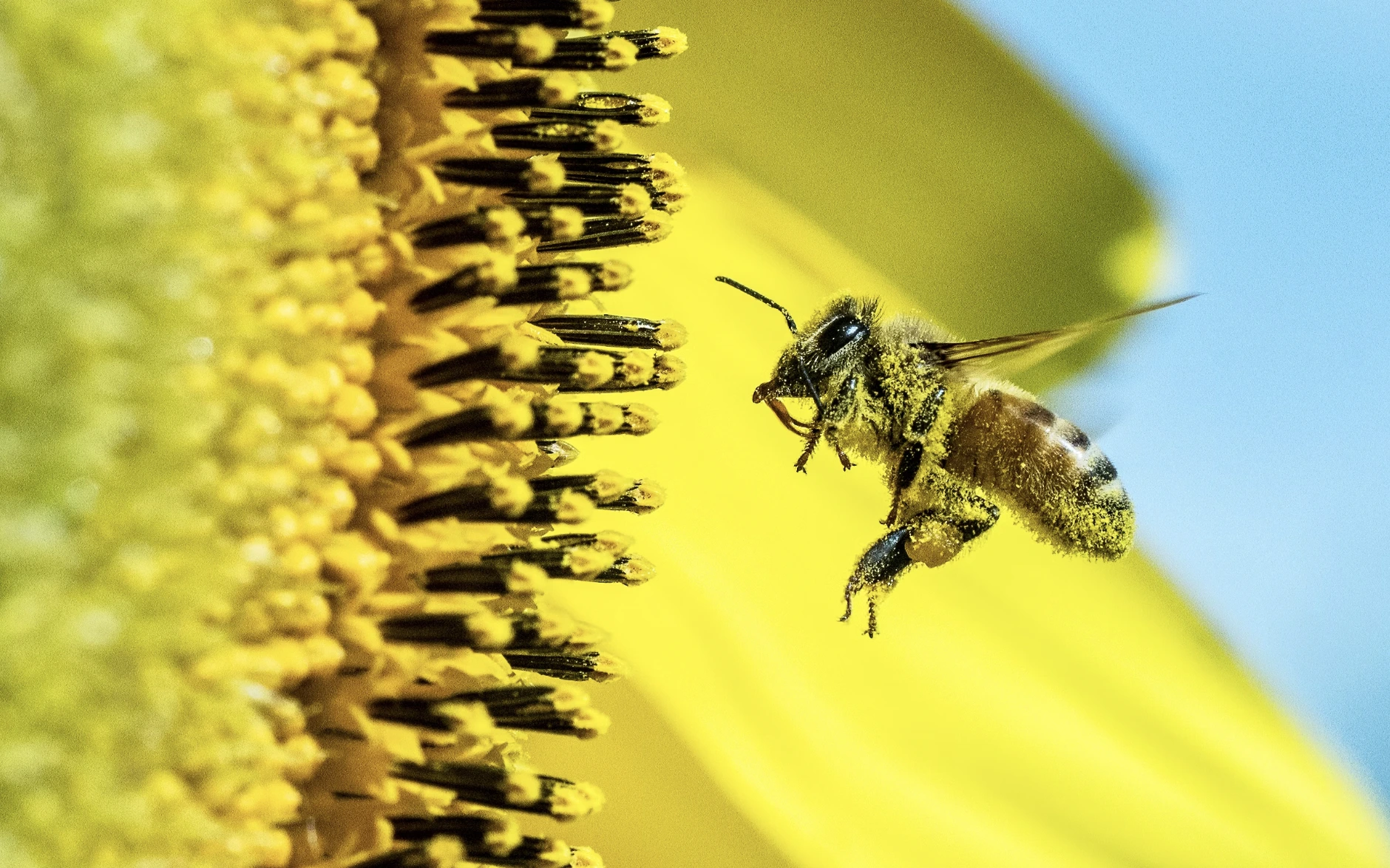
Image by David Clode, from Unsplash
Could These Agile Robotic Insects Replace Bees In Pollination?
- Written by Kiara Fabbri Former Tech News Writer
- Fact-Checked by Justyn Newman Former Lead Cybersecurity Editor
MIT researchers have developed advanced robotic insects, paving the way for efficient artificial pollination and revolutionizing indoor farming.
In a Rush? Here are the Quick Facts!
- Robots execute complex maneuvers, including double flips, while weighing less than a paperclip.
- Redesigned wings and hinges improve lift, stability, and endurance for efficient artificial pollination.
- Researchers aim to equip robots with batteries and sensors for autonomous outdoor navigation.
These tiny aerial robots, inspired by natural pollinators, promise to boost crop yields in multilevel warehouses while reducing agriculture’s environmental impact, as detailed yesterday in MIT’s announcement .
The revamped design enables the robots to hover for over 1,000 seconds—more than 100 times longer than earlier versions —and execute complex maneuvers such as double flips. Weighing less than a paperclip, the robots are faster and more agile, with enhanced flight precision and durability.
Kevin Chen, associate professor in the Department of Electrical Engineering and Computer Science (EECS) at MIT, described the breakthrough as transformative for the field. “With the improved lifespan and precision of this robot, we are getting closer to some very exciting applications, like assisted pollination,” he said, as reported in the announcement.
The new design eliminates inefficiencies in previous models, which featured eight wings that interfered with each other during flight. The current iteration has four wings arranged to optimize lift and stability, freeing up space for potential integration of sensors or batteries.
Additionally, researchers developed advanced transmissions and extended wing hinges to reduce mechanical stress, enhancing endurance and power.
These innovations allow the robots to generate three times more control torque than before, enabling sophisticated flight patterns, such as tracing the letters “M-I-T” mid-air. The robots achieved a record speed of 35 centimeters per second and demonstrated precise trajectory tracking.
Despite these advancements, Chen acknowledged the gap between robotic and natural pollinators. Bees, with just two wings and finely tuned muscles, still outperform their mechanical counterparts in control and efficiency.
“The wings of bees are finely controlled by a very sophisticated set of muscles. That level of fine-tuning is something that truly intrigues us, but we have not yet been able to replicate,” Chen noted.
The robots’ motion is powered by artificial muscles made from elastomer and carbon nanotube electrodes, which generate the force to flap their wings. Researchers overcame challenges in fabricating precise wing hinges, achieving alignment through a meticulous laser-cutting process.
Looking ahead, the team plans to extend flight durations beyond 10,000 seconds and improve precision for tasks like landing on flowers. Integrating batteries, sensors, and computing capabilities will be a central focus over the next few years, enabling the robots to navigate and pollinate autonomously outside the lab.
The study, led by Chen and EECS graduate students Suhan Kim, Yi-Hsuan Hsiao, Zhijian Ren, and visiting student Jiashu Huang, was published in Science Robotics .

Image by Seen, from Unsplash
PowerSchool Cyberattack Compromises Millions Of Student Records Across U.S. Schools
- Written by Kiara Fabbri Former Tech News Writer
- Fact-Checked by Justyn Newman Former Lead Cybersecurity Editor
Hackers breached the systems of PowerSchool, an ed-tech company serving over 50 million students in the U.S.
In a Rush? Here are the Quick Facts!
- Hackers accessed historical student and teacher data in PowerSchool’s December cyberattack.
- Data stolen includes names, addresses, Social Security numbers, and academic records.
- Affected districts report inadequate security measures, like no multi-factor authentication.
The attack, as first reported on Wednesday by TechCrunch , compromised historical student and teacher data from multiple school districts. Occurring in December, it exploited stolen credentials to breach the company’s customer support portal, exposing sensitive information.
Affected school districts revealed the breach’s extensive scope. One district confirmed that “all historical student and teacher data” was accessed, while another district with nearly 9,000 students reported that demographic data for current and former staff and students was compromised, as reported by TechCrunch.
Some districts noted inadequate security measures, such as the absence of multi-factor authentication. PowerSchool has yet to disclose the number of impacted schools, said TechCrunch.
Beth Keebler, a company spokesperson, stated that the affected schools and districts have been identified but declined to share their names publicly to TechCrunch. The company is still determining which individuals’ data may have been accessed and did not provide evidence for its claim that the stolen data has been deleted.
However, in a statement provided to TechCrunch on Tuesday, PowerSchool suggested that most affected customers did not have sensitive data compromised.
Moreover, TechCrunch reports that Menlo Park City School District in California confirmed that data dating back to the 2009-2010 school year had been accessed. Rancho Santa Fe School District, another California district, disclosed that teachers’ login credentials were also compromised.
Mark Racine, CEO of education technology consultancy RootED Solutions, warned that the breach impacts not only PowerSchool’s 18,000 active customers but also former clients, as noted by TechCrunch.
He said that affected student numbers in some districts are up to ten times higher than currently enrolled students, reflecting the long-term data retention involved.
Criticism of PowerSchool’s security practices has mounted, with some districts accusing the company of neglecting basic protections, as reported by TechCrunch.
PowerSchool stated to TechCrunch it has implemented measures to prevent further incidents but has not elaborated on its response or the effectiveness of its actions.
A PowerSchool’s spokesperson told Newsweek : “We have identified the schools and districts whose data was involved in this incident, notified them directly and will be providing updates as we support them through next steps.’’
“PowerSchool is in the process of rolling out a plan in which we will offer to notify individuals whose personal information was involved on our customers’ behalf. We will also be providing credit monitoring or identity protection services if applicable,” the spokesperson added.
As investigations continue, affected districts are taking steps to inform staff and students about the breach while evaluating the long-term implications for their communities.
