
Image by frank mckenna, from Unsplash
Chinese Ports Adopt DeepSeek AI To Enhance Efficiency
- Written by Kiara Fabbri Former Tech News Writer
- Fact-Checked by Sarah Frazier Former Content Manager
China’s ports are increasingly adopting the domestically developed DeepSeek AI model to streamline operations, as first reported by the South China Morning Post (SCMP).
In a Rush? Here are the Quick Facts!
- Ningbo-Zhoushan Port uses DeepSeek AI to speed up container inspections and reduce errors.
- Guangzhou Port integrates DeepSeek AI into billing and equipment management systems.
- Zhoushan Port is testing DeepSeek AI for customer service, cargo handling, and security.
Just weeks after its latest iteration launched in January, several major ports have already integrated or are planning to implement the technology, as reported by SCMP.
Hubei Port Group researcher Yu Jiaxiang emphasized the importance of domestic AI in securing port operations, cargo tracking, and supply chain stability. SCMP reports Yu saying that using domestic technology is vital to ensure data security in port operations, facility layout, and cargo information.
One of the first adopters is Ningbo-Zhoushan Port, the world’s third-largest container port by throughput. The port has begun using DeepSeek AI in its intelligent gate and customer service system.
The new gate technology can recognize over 80% of containers’ unique seal numbers, significantly cutting down on manual verification time, as reported by SCMP.
Container inspections that previously required four staff members can now be conducted by a single worker, according to the port’s owner.
The AI model has also improved fault alert response times, reducing them to within 30 minutes. The DeepSeek-powered gate system has been deployed at multiple terminals, processing around 20,000 twenty-foot equivalent units (TEUs) daily, according to SCMP.
Meanwhile, Zhoushan Port is testing the AI for its 24-hour customer service system, which currently relies on Alibaba’s Tongyi Qianwen model.
SCMP says that the DeepSeek-enhanced system is scheduled for rollout in the first half of the year, with plans to expand its use to cargo handling, gantry cranes, and security operations.
Guangzhou Port, located in Guangdong province, has already implemented DeepSeek AI in its equipment management and billing systems, enabling quicker responses to malfunctions and improving data input accuracy, as noted by SCMP.
Hubei Port Group is also building a logistics management platform powered by AI models, including DeepSeek. The group is exploring AI applications for its new multimodal terminals at Yangluo Port in Wuhan on the Yangtze River, as reported by SCMP.
However, concerns have arisen regarding the security of AI models like DeepSeek. A recent study found significant vulnerabilities in the DeepSeek-R1 model , which could potentially compromise its deployment in critical operations.
The model was susceptible to jailbreak attempts, prompt injection attacks, and the generation of harmful or factually incorrect content. With a risk score of 8.3 out of 10, experts caution organizations to assess security risks thoroughly before integrating AI models.
The rapid adoption of DeepSeek AI in China’s ports comes amid increasing tensions over technological competition between China and the United States. In October, the Biden administration finalized rules restricting U.S. investments in Chinese AI , semiconductor, and quantum technology industries.
These regulations aim to prevent U.S. expertise from aiding China’s advancements in high-tech sectors, particularly those with potential military applications.
At the same time, advancements in robotics continue to shape China’s industrial landscape. The World Robot Conference 2024 in Beijing showcased the growing integration of AI-driven automation in logistics, manufacturing, and customer service industries.
As AI adoption spreads across China’s ports, industry experts highlight the need for comprehensive workforce training. From management to on-site staff, employees must develop AI-related skills to maximize the benefits of automation and data-driven decision-making.
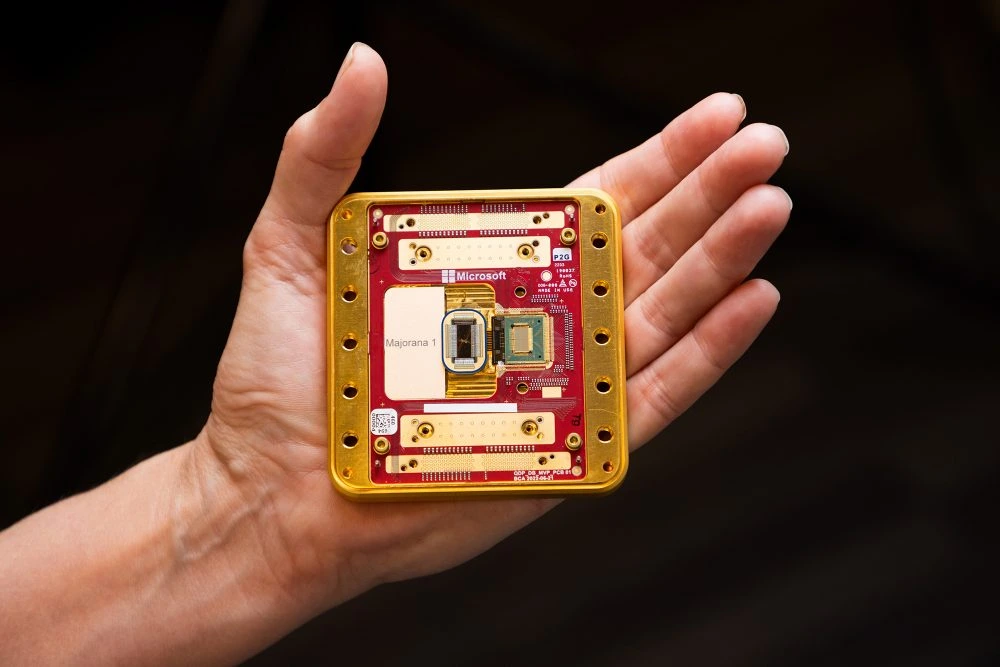
Photo courtesy of Microsoft
Microsoft Introduces Majorana 1, Paving The Way For Scalable Quantum Computing
- Written by Andrea Miliani Former Tech News Expert
- Fact-Checked by Sarah Frazier Former Content Manager
Microsoft introduced this Wednesday its first quantum computing chip, Majorana 1, a technology developed over 20 years.
In a Rush? Here are the Quick Facts!
- Microsoft revealed its first quantum computing chip, Majorana 1, the world’s first QPU powered by topological superconductivity.
- The research team achieved a topological state, a new form of matter, first proposed in 1997.
- The new hardware could accelerate the development of quantum computers from decades to years.
According to the tech giant’s official announcement , the hardware represents the “world’s first Quantum Processing Unit (QPU) powered by a Topological Core.”
The chip has been designed to scale to a million qubits—the popular unit used in quantum computing, quantum bit—and they have built 8 chips so far.
One of the most significant achievements that Microsoft’s scientists managed to reach is the topological state, a new state of matter that was first proposed in 1997 by the Russian American scientist Alexei Kitaev, as reported by the New York Times.
They created the first “topoconductor,” allowing them to develop topological superconductivity, and combine aluminum (a superconductor) and arsenide (a semiconductor) at very low temperatures, adjusted with magnetic fields. The “magic” to their quantum chips.
Microsoft published yesterday a paper with the details of the groundbreaking research in the science journal Nature as well.
“This revolutionary class of materials enables us to create topological superconductivity, a new state of matter that previously existed only in theory,” wrote Dr.Chetan Nayak, Microsoft’s Technical Fellow and Corporate Vice President of Quantum Hardware.
The tech giant shared also a video of the new technology, explaining how they conceived and developed Majorana 1 and its potential for the future of humanity.
In December 2024, Google unveiled its first quantum chip , Willow, capable of performing complex computations in under five minutes that would take today’s fastest supercomputers 10 septillion years.
Now, Microsoft is entering the quantum computing race with a brand-new product, a revolutionary strategy, and groundbreaking research. However, this technology is still in its early stages, and the chip must undergo extensive testing and development—a process that could take years but, optimistically, not decades, as previously predicted—to determine whether it can truly accelerate quantum computing.
