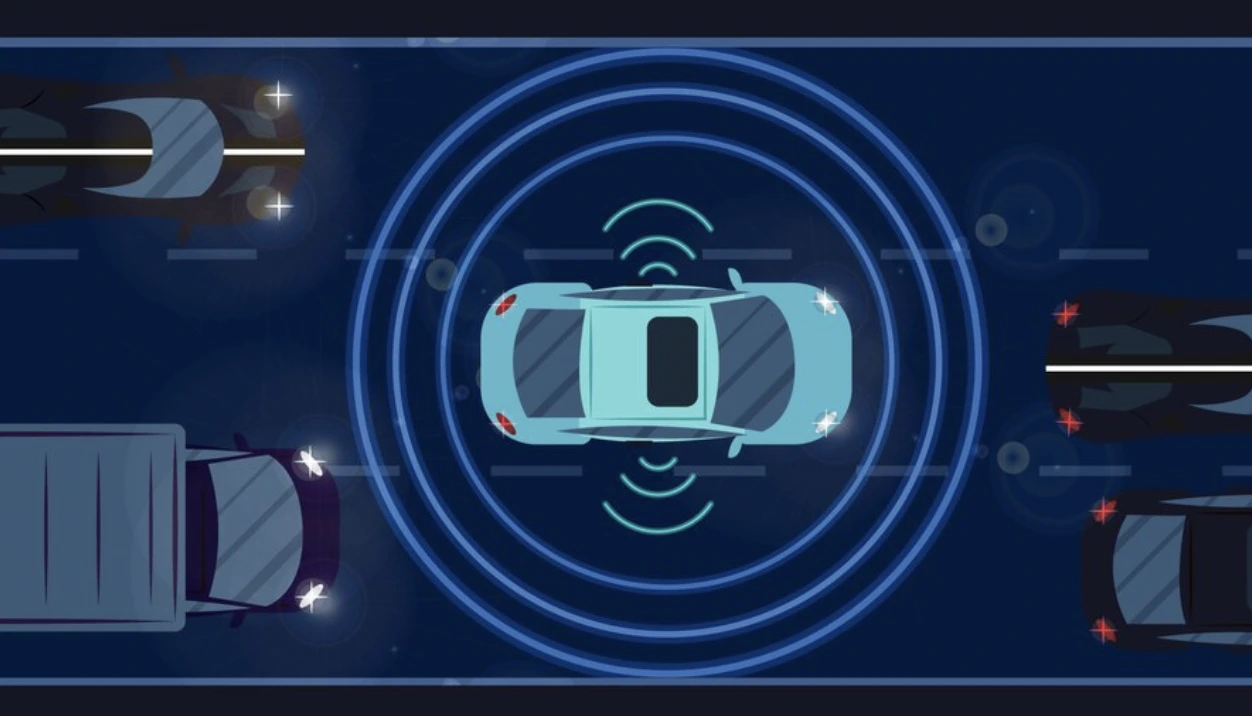
Image from Freepik
ChatGPT To Boost Self-Driving Cars
- Written by Kiara Fabbri Former Tech News Writer
- Fact-Checked by Justyn Newman Former Lead Cybersecurity Editor
In a Rush? Here are the Quick Facts!
- Engineers found LLMs like ChatGPT can enhance AV driving capabilities.
- LLMs help AVs interpret commands naturally, improving user experience.
- AVs using LLMs were rated more comfortable than traditional models.
Purdue University engineers have reported that autonomous vehicles (AVs) can leverage ChatGPT and other chatbots, powered by artificial intelligence algorithms known as large language models (LLMs), to enhance their driving capabilities.
Their study , to be presented Sept. 25 at the 27th IEEE International Conference on Intelligent Transportation Systems , explores how LLMs help AVs interpret passenger commands more naturally, potentially marking a breakthrough in human-vehicle interaction.
Unlike current AV systems, which require precise inputs, LLMs are trained to interpret human speech in a more flexible, conversational manner.
Dr. Wang, the study’s lead researcher, explains that traditional vehicle interfaces often involve pressing buttons or issuing explicit voice commands. On the other hand, LLMs enable a more intuitive and natural dialogue with passengers.
Although LLMs don’t directly control the vehicle, the researchers explained that LLMs can be used to assist the AV’s existing systems, making the driving experience more personalized and responsive to passenger needs.
For their experiment, the research team trained ChatGPT with a variety of commands, both direct and indirect. Examples include, “Drive faster” or “I feel motion sick,” teaching the model to adapt to different situations.
The researchers have tested other chatbots, like Google’s Gemini and Meta’s Llama AI, but found that ChatGPT performed the best.
The model processed these commands while taking into account real-time traffic conditions, weather, and data from the vehicle’s sensors.
The vehicle, which operated at level four autonomy (just one step below fully autonomous), used LLM-generated instructions to control its throttle, brakes, gears, and steering.
In some experiments, Wang’s team tested a memory module they added to the system. This allowed the large language models to store information about the passenger’s past preferences. The models then used that data to personalize their responses to future commands.
Experiments were conducted in a controlled environment, including a former airport runway in Columbus, Indiana, where the AV’s responses to commands were tested at highway speeds and intersections.
The researchers reported that participants found their rides in the LLM-assisted AV more comfortable than in traditional AV systems. The vehicle also consistently outperformed baseline safety standards, even when responding to new commands.
This is especially relevant as self-driving cars are increasingly used as taxis , where personalized experiences may enhance passenger satisfaction.
The large language models used in this study took an average of 1.6 seconds to process a passenger’s command, which is fine for most situations but needs to be faster for emergencies, as noted by Dr. Wang.
While this study didn’t focus on it, large language models like ChatGPT can sometimes “hallucinate,” meaning they misinterpret information and give incorrect responses.
To address this, the team set up safety measures to protect passengers when the models misunderstood commands. The models got better at understanding commands during the ride, but hallucinations still need to be fixed before these models can be used in AVs.
Car manufacturers will also need to run more tests beyond the research already done by universities. In addition, they would need regulatory approval before large language models could be fully integrated into AVs to control the vehicle’s driving functions, said Wang.

Photo by Austin Distel on Unsplash
Slack Announces Multiple New AI Features Including Third-Party AI Agents
- Written by Andrea Miliani Former Tech News Expert
- Fact-Checked by Justyn Newman Former Lead Cybersecurity Editor
In a Rush? Here are the Quick Facts!
- Slack’s interface will include AI agents from Salesforce and partner companies like Adobe and Perplexity
- Workers will interact with AI Agents as if they were teammates
- Slack is becoming a “work operating system”
Salesforce, Slack’s parent company, announced new features and updates for the workplace application yesterday. According to the press release , the new AI features will link Slack to Salesforce and other partner companies.
Among the main features, Salesforce highlighted the integration of Agentforce, Salesforce’s AI agent, within the Slack interface allowing teams to interact with the data and insights in Salesforce. Agentforce will be available in beta mode in October.
For now, the company is already allowing third-party AI agents from parent companies like Anthropic, Perplexity, Adobe, and Cohere to be on the platform—users will find the assistants in Slack Marketplace. A new salesforce channel is also available for Slack Sales Elevate users and the Slack integration will be included in Salesforce Starter Suite in the next few months.
The new features will allow workers to interact with AI agents, as if they were teammates, through the Slack platform in multiple ways, centralizing and linking multiple tools to simplify workflow.
“Work is broken. Desk workers report spending 41% of their day on tasks they consider low-value, nearly half aren’t able to find the information they need to do their jobs, and there are more apps and disconnected work than ever before,” states the document. “Simply adding AI, with even more apps, into an already inefficient work system will only magnify these challenges.”
According to TechCrunch , Denise Dresser, head of Slack, told the tech news site in a recent interview that they want to turn the platform into a “work operating system.”
The new AI updates were announced just a few months after Slack faced criticism for the way they have been training its AI algorithms.
