Braille-Tip, A Pen To Address Declining Braille Literacy
- Written by Kiara Fabbri Former Tech News Writer
- Fact-Checked by Justyn Newman Former Lead Cybersecurity Editor
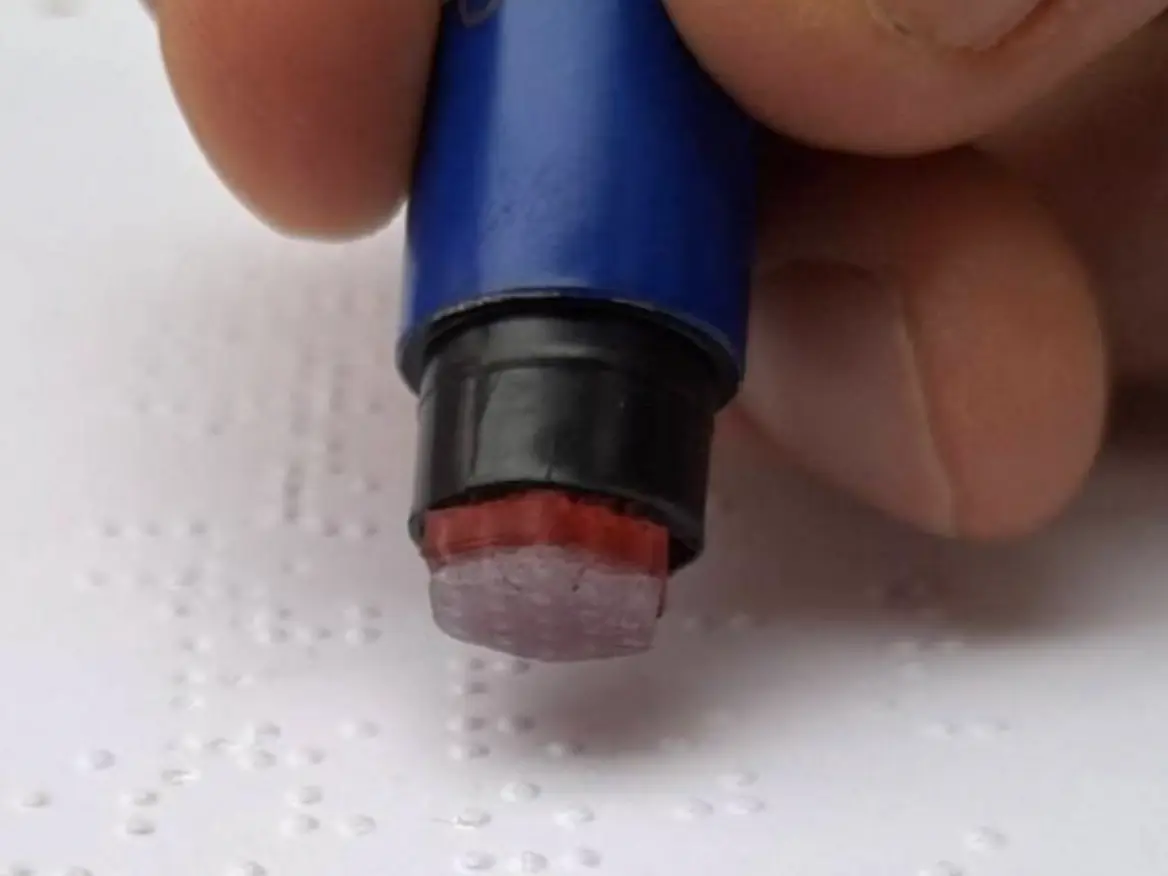
The University of Bristol announced today that its experts have developed a pen capable of converting Braille into English text.
In their research paper , the authors demonstrate the capabilities of a new device called Braille-tip. This compact, soft tactile sensor (11mm in diameter) can be attached to a standard pen and is designed to aid in reading and learning Braille.
It uses fluid channels to relay tactile information from 19 soft taxel membranes to a single camera. The Braille-tip prototype is made from silicone elastomer and tubing, and its sensory response is calibrated to detect 52 raised Braille dots on embossed cardboard.
Their results showed that the Braille-tip can successfully read Braille aloud with an 84.5% accuracy rate when used by hand.
Its small size and the dense arrangement of taxels make it suitable for high-precision, low-force tasks, suggesting potential for integration into everyday items.
The development of the Braille-tip comes at a time when Braille literacy is declining, despite significant demand for learning the language.
Over the past fifty years, braille literacy has sharply declined, with the percentage of individuals with vision loss who read braille hitting an all-time low. In 1960, nearly half of all blind students were fluent in braille, but by 2016, only 8.5% of these students identified as braille readers, according to WCBlind .
This decline is often attributed to a shortage of accessible learning resources, especially in areas outside major urban centers.
The U.S. is experiencing a nationwide shortage of qualified braille teachers . Due to varying state requirements for braille literacy, some students receive less than two to three hours of instruction per week .
Lead author Dr George Jenkinson stated, “This device, Braille-tip, was designed to aid people’s ability to learn independently, and will hopefully form part of the solution to increasing Braille literacy and allow people to reap the benefits of reading and writing.”
This is particularly significant because mathematical and scientific notations can only be fully understood by those proficient in Braille. As noted by Arielle Silverman, president of the Arizona Association of Blind Students.
Generally speaking, Braille literacy is correlated with higher academic achievement and improved employment outcomes for blind and low-vision adults, as reported recently by NPR .
As the need for effective Braille education remains critical, innovations like the Braille-tip may help to improve access and support efforts to reverse the current trends in Braille literacy.
YouTube Launches New Parental Controls For Teens
- Written by Kiara Fabbri Former Tech News Writer
- Fact-Checked by Justyn Newman Former Lead Cybersecurity Editor
YouTube has announced today a new feature designed to enhance parental oversight and provide teens with additional support for responsible content creation.
Rolling out globally this week, the first iteration of this update builds on YouTube’s existing supervised features for pre-teens . Through the new Family Center hub, parents can monitor their teen’s activity on YouTube, receiving email notifications for key events such as video uploads or livestreams.
The company stated that it collaborated with its Youth and Families Advisory Committee to develop the new controls.
They added that YouTube’s youth-focused products, including YouTube Kids and supervised experiences for pre-teens, reach over 100 million active viewers monthly.
YouTube informed TechCrunch that linking accounts will not impact the platform’s algorithm or alter the content shown to teens, as recommendations are already personalized.
Additionally, parents cannot update their child’s real age through account linking, as YouTube relies on the age the teen provided when they first signed up.
Parents will still receive alerts for new uploads on YouTube and YouTube Shorts, including private or unlisted videos, and they’ll be notified whenever video privacy settings are changed, as reported by TechCrunch.
Ellen Selkie, Assistant Professor of Pediatrics at the University of Wisconsin-Madison, praised YouTube’s approach, stating in the announcement, “It’s so important for teens to have space to make their own choices, express themselves, and explore their identity and values. It’s also important to have the wisdom of trusted adults in their lives if they need them.”
“That’s why when I talk with teens and their parents about online activities, I encourage the idea of ‘trust, but verify.’ YouTube’s supervised experience for teens holds these developmental principles by having teens and their parents share decisions about supervision with continued open, two-way communication,” Selkie concluded.
