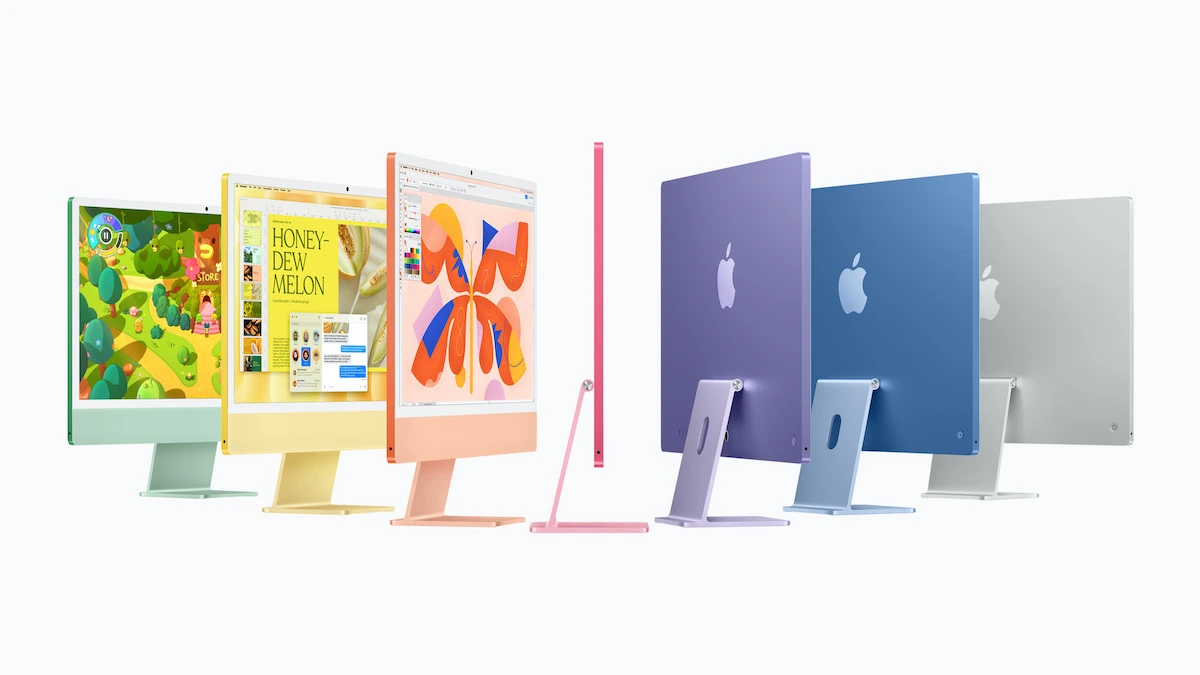
Image courtesy of Apple
Apple Releases New Mac with M4 And Apple Intelligence
- Written by Andrea Miliani Former Tech News Expert
- Fact-Checked by Justyn Newman Former Lead Cybersecurity Editor
In a Rush? Here are the Quick Facts!
- The new iMac includes chip M4 and Apple Intelligence and will be available on November 8th
- The price of the new device starts at $1,299 and it comes in 7 colors
- Apple Intelligence is now available for all users with devices compatible with iOS 18.1,iPad 18.1, and macOS Sequoia 15.1.
Apple announced today a new iMac including the new M4 chip and Apple Intelligence, and released the highly anticipated AI advanced technology Apple Intelligence for all users with compatible devices.
According to the press release , the new iMac is 2.1x faster for demanding tasks like gaming and photo editing and 1.7x faster for daily activities. The screen measures 24 inches and incorporates 4.5K Retina display technology. The M4 chip allows the new device to integrate AI features, including Apple Intelligence, and access to ChatGPT.
“With M4 and Apple Intelligence, gorgeous new colors that pop in any space, an advanced 12MP Center Stage camera, and a new nano-texture glass display option, it’s a whole new era for iMac,” said John Ternus, Apple’s senior vice president of Hardware Engineering.
The new models—launched in seven colors: silver, blue, green, pink, purple, orange, and yellow—are available for pre-order, and the prices start at $1,299 for its standard model with 16GB of memory. It also includes a 12MP camera with Center Stage technology, which automatically adjusts to keep users in the center of the screen. Apple said the new devices will be available on November 8th.
Last week, Apple released the new iOS 18 with Apple Intelligence and ChatGPT integration in beta mode for developers. The upgrade is now available for users with the iPhone 16 models and iPhone 15 Pro or Pro Max, and iPads and Macs that can upgrade to iPad 18.1, and macOS Sequoia 15.1.
“Apple Intelligence introduces a new era for iPhone, iPad, and Mac, delivering brand-new experiences and tools that will transform what our users can accomplish,” said Tim Cook, Apple’s CEO in the press release.
Users with devices compatible with the new technology can now request access in Settings to get added to the waitlist. Users are likely to get access within the same day according to the developer’s previous experience, as reported by CNBC .

Image generated with DALL·E through ChatGPT
Opinion: A New Era of Space Innovation And Fierce Competition Is Here
- Written by Andrea Miliani Former Tech News Expert
- Fact-Checked by Justyn Newman Former Lead Cybersecurity Editor
In the past few years, technology seems to be recycling and relaunching not-so-old ideas. At least ideas I am familiar with, and that I’ve seen going through hype and failure 10 years ago. Now, however, all those sci-fi projects seem to be reborn with better technology and more power, especially in the space sphere.
Back in 2011, there was this huge project called Mars One. It made everyone around me question whether or not they would participate in the extraterrestrial reality show with open applications where over 200,000 registered but only a few thousand actually paid the fee. The initiative, led by the Dutch entrepreneur Bas Lansdorp, failed, and the company declared bankruptcy in 2019.
Now, Elon Musk is working on a new Mars project with his SpaceX company and has also made an open invitation—this time no reality show was promised—and the hype to go to Mars is back on. “In all seriousness, SpaceX hopes to offer travel to Mars to anyone who wants to go, bearing in mind that it will be like a long sea voyage in centuries past – dangerous and uncomfortable, but great adventure!” wrote the CEO on X .
Musk’s ambition is to begin sending humans to Mars by 2028 and the Chinese space company Deep Blue Aerospace sold two tickets —at $210,000 each—for a short space travel experience in 2027 this week. Has the space race been fueled? Are we actually closer to leaving Earth?
SpaceX Getting Closer To Mars
Last week, a historic event occurred: after the fifth test flight for the rocket Starship—the reusable model for the Mars missions—the startup managed to successfully catch the booster using its latest technology in the aircraft and the launch tower—the “Mechazilla.”
Despite the environmentalist’s warnings about SpaceX’s pollution and environmental regulations’s violation, the company seems to be working non-stop to get to Mars as soon as possible. The uncrewed starship models are expected to begin landing on Mars by 2026, and the first interplanetary missions with humans just two years after.
Whether we like it or not, the booster catch was a huge success in science and engineering and had a significant impact on the industry. This milestone not only represents a big step in technology development but also a boost in enthusiasm for future missions as it means that costs can be dramatically reduced. The Super Heavy booster reuse could save the company $10 million in multiple future launches.
NASA, ESA, and Other Established Organizations Are Lagging Behind
The National Aeronautics and Space Administration (NASA) administrator Bill Nelson applauded SpaceX’s milestone and seems content with the organization’s alliances. Crew-8 with NASA astronauts just arrived back on Earth in SpaceX’s Dragon rocket Endeavour, but there’s a thought that keeps popping up in people’s minds: Is NASA lagging behind?
“It must hurt NASA knowing that they are no longer on the frontier of space exploration,” wrote one user on X in the video NASA shared of the rocket’s return. NASA is advancing at a different pace, and while NASA’s focus and mission are different from SpaceX’s, there seems to be a constant comparison that is placing NASA and other established institutions behind the new space startups and projects.
In a recent study on the effect of space on the human body , the collaborative project Space Omics and Medical Atlas (SOMA) shared results on their Inspiration4 mission in which the crew used new technology like Apple Watches and modern sensors for experiments and noted that NASA still uses test models from 1970.
The European Space Agency (ESA) chief, Josef Aschbacher, shared his concerns about future activities in space and urged European organizations in the industry to be more ambitious . “Europe needs to accelerate its activities in space, needs to raise its profile, needs to raise its ambition, otherwise we will risk falling behind,” said Aschbacher in a recent interview.
The Private Sector Takes the Lead
SpaceX is not the only space company taking big steps. Jeff Bezos’s aerospace company Blue Origin launched and landed its New Shepard spacecraft this week. It was an uncrewed test, but the ship is designed for passengers as the company expects to offer suborbital trips for people soon.
Not all these space companies are in the United States, not all intend to send humans to space, and not all are getting perfect results. The Japanese startup Space One launched a rocket that exploded this week , it was expected to deliver the first private Japanese satellite in orbit.
But what is certain is that more space startups keep emerging. Just in the past few weeks, Robinhood’s cofounder launched space-based solar power company Aetherflux , the Indian government said it will support 40 space startups to develop their projects, the Spanish satellite startup Sateliot recently raised €10 to launch nanosatellites, and British billionaire Richard Branson, Virgin Galactic founder, announced he will copilot startup Space Perspective’s first space balloon flight next year.
Many of these startups’ focus might not be taking humans to space, but their development, research, and innovation are fueling the space travel movement. Just like smart glasses made a comeback this year and we might be wearing them in just a few months, space travel seems to be getting closer. First, let’s see NASA send astronauts on its Artemis II mission around the moon next year.
