
- Written by Deep Shikha Content Writer
- Fact-Checked by
Dr. Andrew Ng holds several key roles in the AI field. He manages AI Fund, a venture studio for AI startups; leads DeepLearning.AI, an AI education company; founded Landing AI, specializing in computer vision software; and co-founded Coursera, an online learning platform. He is also an adjunct professor at Stanford University.
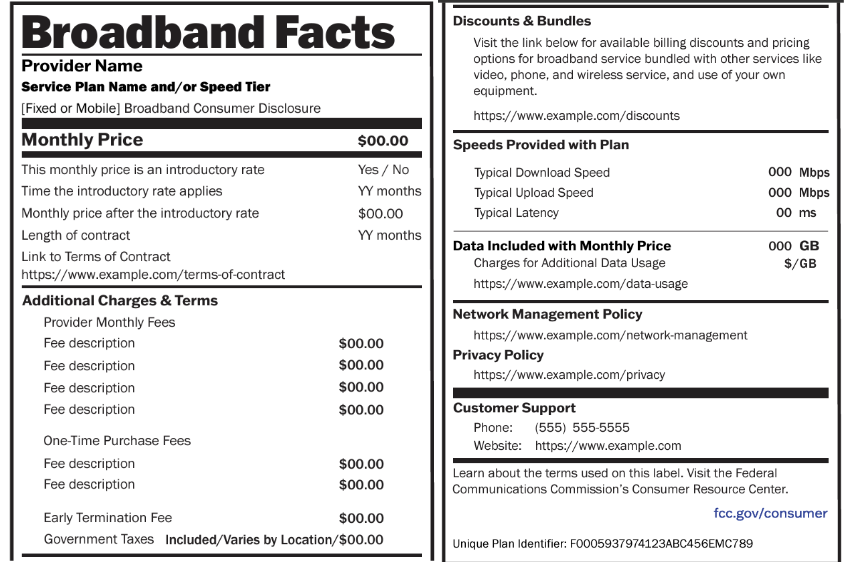
FCC Mandates “Broadband Nutrition Labels” To Be Displayed by ISPs for Most Broadband Plans
- Written by Elijah Ugoh Cybersecurity & Tech Writer
US Consumers will start seeing nutrition-like labels on most broadband plans at the store and online starting on April 10. This is due to the recent FCC policy directing all major internet service providers (ISPs) to publish broadband “nutrition labels” on all their internet plans.
The FCC formally proposed these nutrition labels for US internet service providers in 2016, according to The Verge. Now, it’s finally happening. The policy is effective immediately, as directed in the FCC’s press release of April 10.
“The labels are modeled after the FDA nutrition labels and are intended to help consumers comparison shop for the internet service plan that will best meet their needs and budget. Internet service providers that offer home or fixed internet services, or mobile broadband plans are required to have a label for each service plan they offer,” the agency clarified on its website .
The FCC released a sample of the label to give consumers an idea of what to expect. There’s also a glossary to help consumers better understand the information displayed on the label.
“Today is an exciting day for consumers. Broadband Nutrition Labels are finally here. Consumers across the country can now benefit from consistent, transparent, and accessible point-of-sale information about broadband prices and services,” said FCC Chairwoman Jessica Rosenworcel.
Rosenworcel expressed enthusiasm for the newly established transparency, stating that US consumers could use the “nutrition label” disclosures to hold providers to their promises and benefit from “greater competition — which means better service and prices for everyone.” The FCC also recently updated the broadband threshold from 25Mbps/3Mbps to 100Mbps/20Mbps, requiring ISPs to improve their service offerings to US consumers.
“If a provider is not displaying their labels or has posted inaccurate information about its fees or service plans, consumers can file a complaint with the FCC Consumer Complaint Center at https://consumercomplaints.fcc.gov ,” says the Commission.
The Commission’s directive, established under the Bipartisan Infrastructure Law of 2021, seeks to establish more transparency in broadband services. Under this legislation, the FCC (in 2022) adopted rules requiring broadband providers to display, at the point of sale, labels displaying key information consumers want: prices, speeds, fees, data allowances, and other critical information.
